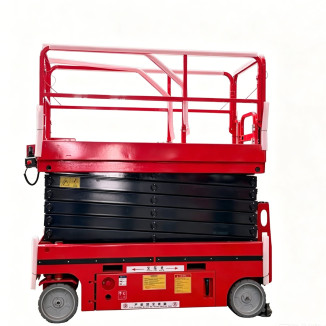
Scissor Lift: Electric & Hybrid Models Reshaping Global Aerial Work Industry 2026
Scissor Lift | Electric & Hybrid Scissor Lift for Global Aerial Work
Explore high-performance scissor lift, electric scissor lift, hybrid scissor lift solutions. Check 2026 market trends, specs & B2B procurement guidance.
The global aerial work platform industry is undergoing a profound green and intelligent transformation, with scissor lift equipment standing as the most widely used vertical access solution for construction, industrial maintenance, warehouse logistics and urban engineering projects worldwide. As global emission regulations tighten and enterprises prioritize low operational costs and high work efficiency, traditional fuel-powered scissor lifts are gradually being replaced by advancedelectric scissor lift and hybrid scissor lift models. This article comprehensively analyzes the 2026 global scissor lift market landscape, core product advantages, technical specifications, application scenarios and industry trends, providing authoritative procurement references for international B2B buyers, engineering contractors, equipment rental companies and industrial manufacturers.
1. Global Scissor Lift Industry Background & 2026 Market Data
The scissor lift market has maintained steady growth driven by booming global urbanization, infrastructure renovation and intelligent industrial upgrading. In 2025, the global scissor lift market scale exceeded USD 1
.34 billion, with North America dominating 39.2% of the market share relying on mature construction systems and complete equipment rental infrastructure, while the Asia-Pacific region follows closely with 34.7% share due to rapid infrastructure expansion in emerging economies. Europe accounts for 26% of the market, driven by strict environmental protection policies that accelerate the phase-out of hig
h-emission fuel equipment.
From product segmentation, traditional diesel scissor lifts once occupied the mainstream market, but their market share is projected to drop to 21.4% by 2034. In contrast, new energy scissor lift products show explosive growth. The electric scissor lift segment maintains a 6.15% compound annual growth rate (CAGR) from 2026 to 2031, while the hybrid scissor lift market boasts a higher CAGR of 7.1%–8.9%, becoming the fastest-growing subdivision in the aerial work equipment industry. In 2025, hybrid scissor lifts captured 11.3% of the global market share, and this proportion is expected to continue rising in the next five years.
For B2B buyers, the shift in market structure means low-energy, low-emission, multi-scenario adaptable scissor lift products have become the core procurement trend. Electric and hybrid scissor lifts no longer serve as niche alternative products but have evolved into standard configuration tools for global engineering and industrial operations.
2. Core Product Classification & Technical Specification Comparison
Standard scissor lift products are divided into three core categories: conventional scissor lift, electric scissor lift, and hybrid scissor lift. Each model has unique technical parameters, power systems and applicable scenarios, meeting differentiated operational demands of indoor and outdoor, static and complex working environments.
2.1 Conventional Scissor Lift
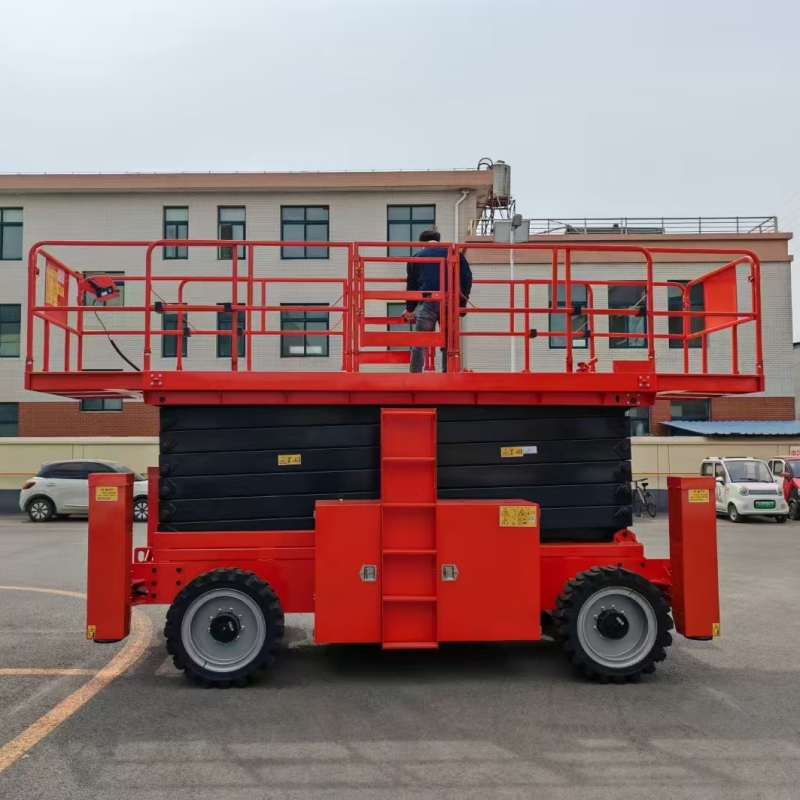
Traditional scissor lifts are mostly diesel-powered, designed for heavy-duty outdoor rough-terrain operations. Equipped with robust scissor arm structures and large-load chassis, these lifts feature a maximum working height of 6–18 meters and a load capacity of 300–500kg. They excel in strong power and high terrain adaptability, suitable for open-air construction, road engineering and large-scale outdoor renovation projects. However, their obvious drawbacks include high fuel consumption, loud operating noise and exhaust emissions, which restrict their use in indoor closed spaces and low-emission restricted areas.
2.2 Electric Scissor Lift
The electric scissor lift is a pure battery-powered vertical access device, optimized for indoor and urban low-noise, zero-emission working scenarios. Powered by high-performance lithium-ion batteries, it supports 6–8 hours of continuous operation on a single charge, with no exhaust emission and operating noise controlled below 65dB. Its core technical advantages include compact body design, flexible steering, stable lifting operation and low maintenance cost.
Mainstream electric scissor lift specifications cover working heights of 4–14 meters and load capacities of 230–450kg. Equipped with intelligent constant-speed lifting systems and anti-tilt safety protection devices, it fully complies with EU CE and US ANSI safety standards. Widely applied in warehouse cargo handling, factory equipment maintenance, mall decoration, airport interior maintenance and data center construction, it is the preferred equipment for modern indoor aerial work.
2.3 Hybrid Scissor Lift
The hybrid scissor lift integrates diesel power and electric drive dual systems, solving the scenario limitations of single-power scissor lifts perfectly. It can freely switch between electric mode and diesel mode according to working environments: electric mode for zero-emission indoor operations, and diesel mode for high-power outdoor rough-terrain operations. This dual-mode design extends the continuous working time effectively, eliminating the charging dependency of pure electric models.
In terms of technical parameters, hybrid scissor lifts support working heights of 8–16 meters, with enhanced terrain adaptability and waterproof and dustproof performance. Equipped with intelligent energy-saving systems, it reduces fuel consumption by 30% compared with traditional diesel scissor lifts, while ensuring stronger power output than electric models. It is the most cost-effective multi-scenario aerial work equipment for engineering teams and rental enterprises.
3. Manufacturing Process & Application Field Analysis
3.1 Standard Manufacturing Process of Scissor Lift
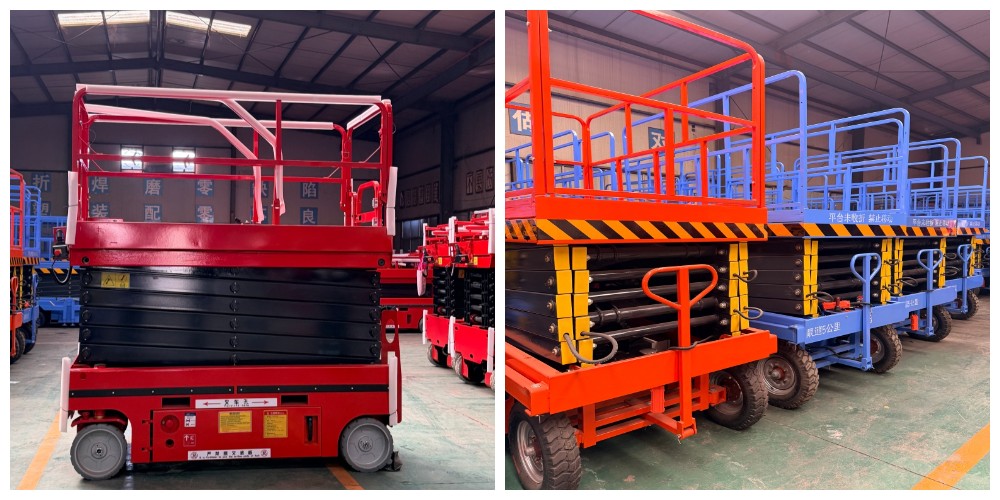
High-quality scissor lift products adopt standardized industrial manufacturing processes to ensure structural stability and operational safety. The whole process includes five core links: precision steel cutting and forming, robotic welding, surface anti-corrosion treatment, power system assembly, and intelligent debugging. First, high-strength manganese steel is selected for scissor arm and chassis processing to improve load-bearing capacity and anti-deformation performance. Second, full-automatic robotic welding ensures uniform welding seams and structural firmness. After sandblasting and electrostatic spraying anti-corrosion treatment, the equipment can resist outdoor wind and rain erosion and extend service life.
For electric and hybrid scissor lifts, professional power system calibration is added in the later stage. The lithium battery pack, motor and intelligent control system are precisely matched through professional debugging equipment to ensure stable power output and accurate lifting control. All finished products pass 100% load testing, anti-tilt testing and continuous operation testing before leaving the factory, meeting international export safety standards.
3.2 Core Application Scenarios
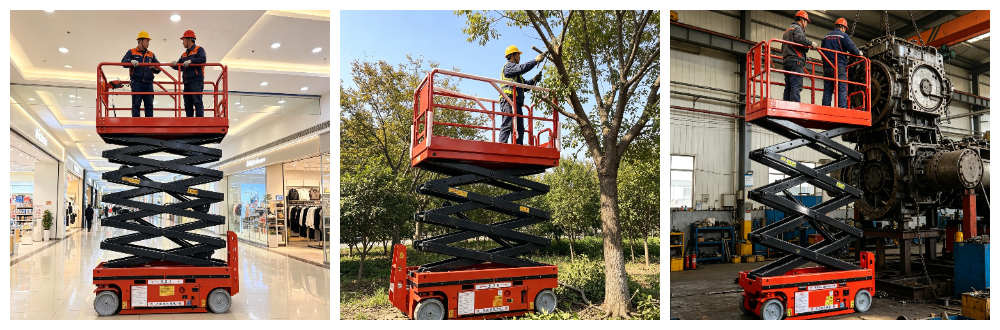
Electric scissor lift focuses on indoor and urban green construction scenarios, widely used in logistics warehousing, industrial workshop maintenance, commercial building decoration, municipal indoor engineering and clean environment operations. Its zero-emission and low-noise features meet the environmental requirements of closed spaces and urban core areas.
Hybrid scissor lift covers full-scenario operations, suitable for construction projects requiring frequent switching between indoor and outdoor work, such as urban building renovation, bridge auxiliary maintenance, outdoor landscape engineering and multi-stage construction projects. It greatly improves equipment utilization rate for rental enterprises and engineering contractors.
Conventional scissor lifts are still applied in large-scale outdoor infrastructure construction, open-air mining auxiliary operations and remote engineering projects with insufficient power supply.
4. 2026 Core Industry Development Trends
The global scissor lift industry is moving toward greenization, intelligence and low total cost of ownership (TCO), with three major trends leading market development.
First, new energy replacement accelerates. Global carbon neutrality policies push construction and industrial equipment to upgrade environmentally. Electric scissor lift and hybrid scissor lift have become mainstream procurement choices, and many European and American regions have issued restrictions on high-emission fuel aerial equipment, further expanding new energy product market space.
Second, intelligent technology popularizes rapidly. More than 28% of mid-to-high-end scissor lift products are equipped with IoT telematics systems, supporting remote equipment monitoring, predictive maintenance and fleet management. Intelligent load sensing, automatic leveling and obstacle avoidance systems greatly improve operational safety and work efficiency, becoming standard configuration for high-quality export scissor lifts.
Third, compact and high-efficiency design becomes mainstream. Urban construction space is increasingly compact, driving manufacturers to optimize product structure. Modern electric and hybrid scissor lifts feature lightweight body, narrow chassis and strong passability, adapting to narrow construction spaces such as urban streets and indoor workshops.
5. B2B Buyer FAQ for Scissor Lift Procurement
Q1: What is the key difference between electric scissor lift and hybrid scissor lift for project procurement?
The core difference lies in power mode and scenario adaptability. Electric scissor lift is pure electric, zero-emission and low-noise, suitable for long-term indoor and urban low-carbon projects with sufficient power supply, featuring lower maintenance costs. Hybrid scissor lift supports dual power switching, adapting to mixed indoor and outdoor working scenarios, with stronger terrain adaptability and no charging restriction, ideal for multi-scenario engineering teams and rental fleets pursuing high equipment utilization.
Q2: Are electric and hybrid scissor lifts compliant with international export safety standards?
Qualified export-grade electric scissor lift and hybrid scissor lift fully comply with EU CE, US ANSI and ISO international safety standards. All products are equipped with anti-tilt protection, emergency stop device, overload protection and fault self-diagnosis systems. The lithium battery system passes strict explosion-proof and safety testing, adapting to various international engineering certification requirements, supporting global door-to-door delivery and project use.
Q3: Which model has lower long-term operating cost for fleet rental business?
Electric scissor lifts have the lowest long-term TCO, with lithium battery packs requiring no daily fluid maintenance and reducing routine maintenance hours by 50% compared with fuel models. Hybrid scissor lifts balance initial cost and operational flexibility, with 30% lower fuel consumption than traditional diesel lifts. For long-term rental fleets, matching electric models for indoor business and hybrid models for outdoor mixed business can maximize profit margins.
Q4: What is the service life and after-sales guarantee of export scissor lifts?
Standard export scissor lift equipment has a service life of 8–10 years. Electric and hybrid models adopt durable lithium battery packs with a cycle life of over 2000 times. Formal foreign trade manufacturers provide 1–2 years of global warranty service and lifelong technical support, with spare parts supply channels covering mainstream global regions, ensuring stable equipment operation for overseas projects.
6. Professional CTA for Global B2B Buyers
As the global aerial work industry continues to upgrade, choosing high-quality, standard-compliant and cost-effective scissor lift, electric scissor lift and hybrid scissor lift is crucial to improving project efficiency and reducing operational costs. We provide full-range customized scissor lift solutions covering standard models, customized height and load specifications, and OEM export services. All products strictly follow international manufacturing standards, with complete certification documents and reliable after-sales support.
Whether you are an engineering contractor, equipment rental company or industrial procurement enterprise, you can contact our professional foreign trade team to obtain the latest 2026 product catalog, real-time quotation and customized procurement solutions. We support flexible batch ordering, global logistics delivery and one-stop export services to help your business seize the high-growth new energy aerial work equipment market.