Scissor Lift & Industrial Transfer Trolley: Electric Scissor Lift for Modern Material Handling
Scissor Lift, Electric Scissor Lift & Industrial Transfer Trolley Guide
Source scissor lift, electric scissor lift & industrial transfer trolley. Explore 2026 market data, specs, trends and B2B procurement guidance for global buyers.
1. Global Industry Background & Market Overview
1.1 Integrated Material-Handling Equipment on the Rise
Global manufacturing, logistics and construction sectors continue to invest in safer, more efficient material-handling and aerial-access equipment. Three product categories have emerged as essential building blocks of modern operations: the scissor lift for vertical access, the electric scissor lift for emission-free indoor work, and the industrial transfer trolley for heavy-load horizontal transport within factories, warehouses and construction yards.
Together, these three equipment types cover the full vertical-and-horizontal material-handling spectrum. A scissor lift elevates workers and tools to working heights; an electric scissor lift does so quietly and without exhaust fumes indoors; an industrial transfer trolley moves heavy pallets, moulds, coils and machinery across factory floors and between production lines. For international B2B buyers—especially distributors, rental companies and large facility operators—sourcing all three from a single qualified manufacturer reduces procurement complexity and streamlines after-sales support.
1.2 Key Market Statistics for 2026
According to 2026 industry research, the global aerial work platform market is projected to reach USD 15.8 billion in 2026, with the scissor lift segment accounting for approximately 38% of unit shipments. Within that segment, the electric scissor lift now represents over 55% of new-unit sales in mature markets such as North America and Western Europe, driven by tightening indoor-emission regulations and warehouse-automation growth.
Meanwhile, the global industrial transfer trolley market is estimated at USD 1.2 billion in 2026 and is forecast to grow at a CAGR of around 5.8% through 2032, fuelled by expanding manufacturing bases in Southeast Asia, India and Mexico, as well as rising demand for automated guided vehicle (AGV) and rail-guided transfer solutions. Asia-Pacific accounts for roughly 44% of global industrial transfer trolley consumption, followed by Europe and North America.
2. 2026 Market Trends Reshaping Procurement
2.1 Electrification Across All Three Categories
Electrification is the dominant trend across both vertical and horizontal handling equipment. The electric scissor lift has already become the default choice for indoor maintenance, fit-out and warehouse tasks due to zero-emission, low-noise operation. Similarly, battery-powered industrial transfer trolley models are rapidly replacing diesel and cable-powered units, offering greater flexibility, lower operating cost and cleaner operation inside enclosed production facilities.
2.2 Automation and Smart-Control Integration
Buyers increasingly request built-in diagnostic systems, GPS tracking, remote fault-reading and even semi-autonomous navigation. For the industrial transfer trolley, this means PLC-controlled routing, obstacle-detection sensors and AGV compatibility. For the scissor lift and electric scissor lift, this translates to platform load sensing, tilt protection, operator-presence sensing and telematics-enabled fleet management—features once considered premium but now expected as standard by large rental fleets.
2.3 Safety-Standard Compliance as a Non-Negotiable Factor
International standards such as ANSI A92.20 (North America) and EN 280 (Europe) continue to tighten requirements for aerial work platforms. For the industrial transfer trolley, standards such as ISO 3691-4 (driverless industrial trucks) and regional machinery-safety directives apply. Professional buyers now verify that every scissor lift, electric scissor lift and industrial transfer trolley they source carries the relevant CE, ANSI or ISO certification, along with factory load-test records and complete technical documentation.
Relevant long-tail keywords reflecting real buyer demand: electric scissor lift for indoor warehouse maintenance, battery-powered industrial transfer trolley for factory floor, CE certified scissor lift for European rental fleets, rail-guided industrial transfer trolley for heavy mould transport, compact electric scissor lift for narrow-aisle facility work.
3. Technical Introduction: Scissor Lift, Electric Scissor Lift and Industrial Transfer Trolley
3.1 Scissor Lift Core Structure and Working Principle
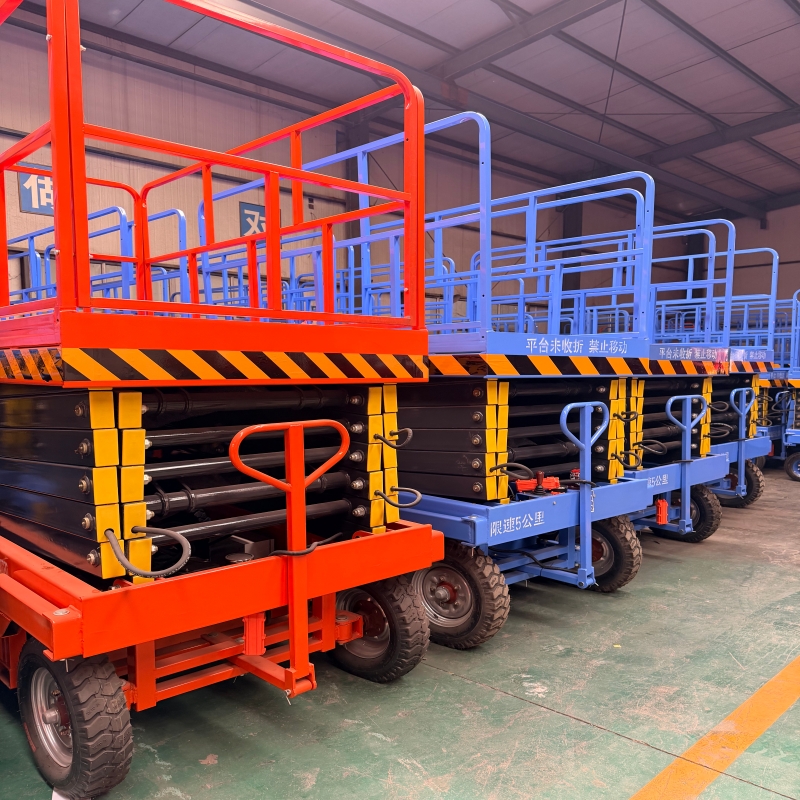
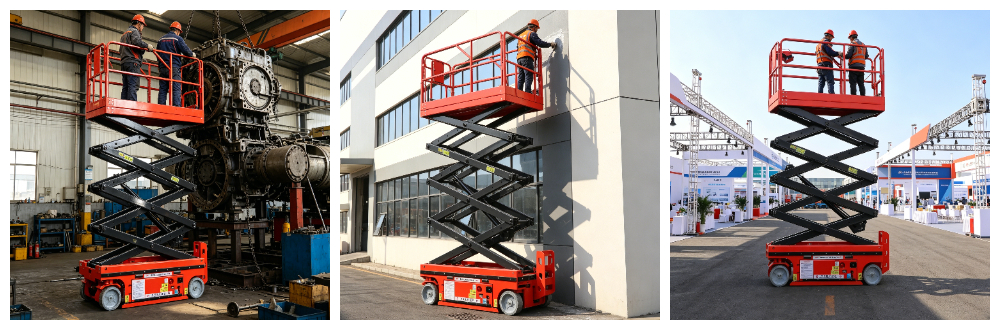
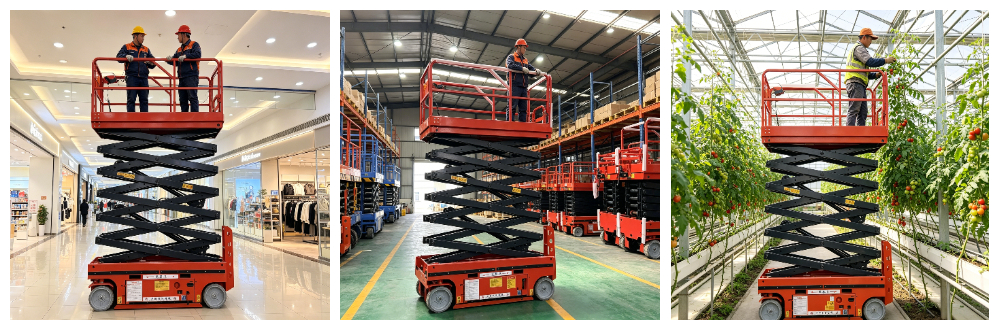
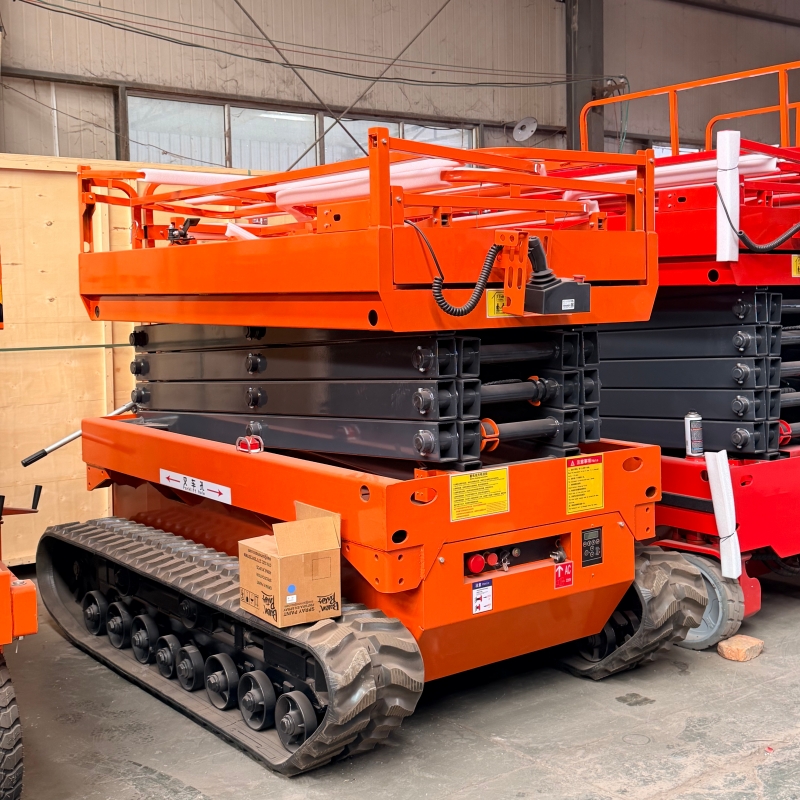
A standard scissor lift consists of a crisscross scissor-arm mechanism, a work platform, a self-propelled chassis, a hydraulic or electric actuation system and an integrated control panel. When the actuation system extends the scissor arms, the platform rises vertically while remaining perfectly level. The large platform surface—typically 1.5 m² to 4.5 m²—allows multiple workers and tools to operate simultaneously, making the scissor lift highly efficient for ceiling installation, ductwork, lighting maintenance and inventory picking.
Common working heights range from 6 m to 16 m, with platform capacities from 230 kg to 680 kg. Compact models fit through standard doorways and operate in narrow aisles, while large-deck models serve warehouse and exhibition-centre applications.
3.2 Electric Scissor Lift Technical Advantages
The electric scissor lift uses 24 V or 48 V battery packs—AGM, gel or lithium configurations—paired with DC drive motors and hydraulic lift circuits. Key advantages include zero exhaust emission, operation noise below 70 dB, lower daily energy cost compared with diesel units, and full suitability for enclosed spaces such as warehouses, shopping malls, hospitals and data centres. Modern electric scissor lift models feature proportional controls, automatic pothole protection, tilt alarms and onboard diagnostic displays, enabling precise and safe operation by a single user.
3.3 Industrial Transfer Trolley Configurations and Capabilities
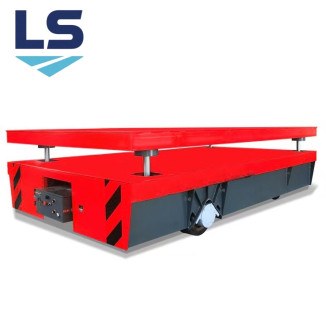
An industrial transfer trolley is a heavy-duty, low-profile platform vehicle designed to transport loads ranging from 1 ton to over 100 tons across factory floors, warehouses and construction sites. It is available in several power and guidance configurations: battery-powered (most flexible), rail-guided (for fixed routes and very heavy loads), cable-reel powered (for continuous-duty applications), and AGV/semi-autonomous (for automated production lines). Key components include a reinforced steel frame, heavy-duty drive axles, industrial-grade wheels or rail wheels, a battery or power-supply system, and a PLC control panel with emergency-stop functionality.
Typical applications include moving injection moulds between storage and presses, transporting steel coils in metalworking plants, shifting prefabricated components in construction yards, and transferring heavy machinery during assembly-line reconfiguration.
4. Manufacturing Process and Application Workflow
4.1 Standard Manufacturing Process for Electric Scissor Lift and Industrial Transfer Trolley
Production of professional-grade equipment follows a rigorous industrial workflow. First, high-strength steel plates and profiles are CNC-cut and formed into chassis, scissor arms, platform frames or trolley bed structures. Second, robotic welding is applied to critical load-bearing joints, followed by non-destructive inspection of high-stress welds. Third, all metal assemblies undergo shot-blasting and multi-layer anti-corrosion painting to withstand outdoor and industrial environments. Fourth, hydraulic cylinders, drive motors, battery packs, control systems and safety sensors are assembled and wired. Fifth, every finished electric scissor lift undergoes full-load lifting tests, emergency-stop verification and tilt-protection testing, while every industrial transfer trolley completes load-bearing deflection tests, brake-performance checks and a 24-hour functional run-in. Final inspection, labelling, documentation sorting and export packaging conclude the process.
4.2 Typical On-Site Application Workflow
For an electric scissor lift: the operator inspects the work area for ground stability and overhead obstacles, drives the machine to the working position, raises the platform to the required height using the platform control panel, completes the maintenance or installation task, then fully lowers the platform and returns the unit to a charging area.
For an industrial transfer trolley: the load is placed onto the trolley bed via forklift, crane or integrated roller system; the operator confirms the load is secured and within rated capacity; the trolley is driven or guided along the designated route to the destination; the load is offloaded; and the trolley returns to its charging or standby position. For rail-guided models, the route is fixed and the trolley can be operated via remote control or programmed for automated cycles.
5. International Buyers' Procurement Preferences and Common Pain Points
5.1 Core Procurement Preferences
Global B2B buyers prioritise four factors when sourcing a scissor lift, electric scissor lift or industrial transfer trolley: (1) certification matching the destination market, (2) rated capacity and working parameters aligned with actual job requirements, (3) total cost of ownership including battery life, spare-part availability and maintenance intervals, and (4) supplier capability to provide technical drawings, operation manuals and responsive after-sales support. Distributors and rental fleets additionally value consistent build quality and strong residual value.
5.2 Common Sourcing Pain Points
Capacity overstatement: Some suppliers advertise rated loads that do not account for dynamic working conditions, leading to premature structural wear or safety risks.
Certification gaps: Non-compliant units cannot clear customs or pass local safety inspections, causing costly project delays.
After-sales weakness: Overseas buyers struggle to obtain spare parts, battery replacements and remote troubleshooting for both electric scissor lift and industrial transfer trolley models.
Poor site-adaptation: Buyers sometimes order standard equipment without measuring aisle widths, floor-load limits, rail-gauge requirements or ceiling heights, resulting in units that cannot be deployed effectively.
6. Frequently Asked Questions from Global B2B Buyers
Q1: How do I decide between a scissor lift and an industrial transfer trolley for my facility?
A: These two products serve different functions. A scissor lift (or electric scissor lift) elevates workers and tools vertically for maintenance, installation or picking tasks. An industrial transfer trolley moves heavy loads horizontally across a facility. Many large warehouses and factories require both—use the scissor lift for vertical access and the industrial transfer trolley for heavy horizontal transport.
Q2: What certifications are required for importing an electric scissor lift or industrial transfer trolley into Europe or North America?
A: For the European market, CE certification under the Machinery Directive is essential for both product types; the electric scissor lift should additionally comply with EN 280. For North America, ANSI A92.20 applies to scissor lifts, while industrial transfer trolleys must meet relevant OSHA and ISO standards. Always request test reports, certificates and material inspection documents before ordering.
Q3: Can the industrial transfer trolley be customised for special loads or routes?
A: Yes. Reputable manufacturers support customisation of load capacity, platform dimensions, wheel type (solid rubber, polyurethane or rail), guidance system (free-running, rail-guided or AGV), and battery configuration. Provide your load specifications, route layout, floor conditions and operating environment to receive an accurate custom quotation and lead-time confirmation.
Q4: How long does the battery last on a typical electric scissor lift, and are replacements available?
A: A well-maintained electric scissor lift can operate a full 8-hour shift on a single charge, depending on load and lifting frequency. Battery packs typically last 3–5 years under normal use. Professional suppliers offer compatible replacement packs and can advise on lithium upgrades for longer runtime and lower maintenance.
7. Get Your Integrated Procurement Solution
Whether you are equipping a new warehouse, modernising a manufacturing facility or expanding a rental fleet, selecting the right combination of scissor lift, electric scissor lift and industrial transfer trolley directly impacts operational efficiency, workplace safety and total cost of ownership.
If you are ready to source these products for your distribution business, rental fleet or end-user project, please share your working-height requirements, load-capacity needs, target-market certification standards, site conditions and estimated order quantity. Our engineering and export team will provide formal quotations, complete technical documentation, product specifications and sample-test records, and can arrange factory inspection or video walkthroughs to support your procurement decision.