Portable Loading Ramp – Advantages & Complete Industry Application Analysis
Portable Loading Ramp – Advantages & Full Industry Application Guide
This guide covers core strengths, market trends, manufacturing process & use cases of portable container ramp and loading dock ramp, with buyer FAQs for global B2B importers’ reference.
1. Global Loading Ramp Industry Background & Market Development Trends
With the continuous expansion of cross-border e-commerce and export manufacturing worldwide, the demand for container cargo loading and unloading rises year by year. As essential logistics equipment for warehouses without fixed docks, portable container ramps and loading dock ramps maintain steady market growth.
Authoritative industry data shows the global portable loading ramp market reached USD 1.67 billion in 2025, and is projected to exceed USD 2.67 billion by 2034, representing a CAGR of 5.2%. The Asia-Pacific region accounts for 38.5% of the total market share, with small & medium-sized factories and cross-border warehouses in Southeast Asia, Europe and North America as core consumer groups.
1.1 Core Drivers of Rising Market Demand
1. Limited infrastructure budgets for small & medium factories: Over 65% of newly built overseas processing plants and temporary warehouses lack fixed loading docks. Civil construction for permanent docks incurs huge costs, while lightweight mobile loading ramps drastically cut upfront investment.
2. Higher requirements for container handling efficiency: Simple wooden or steel planks deliver low efficiency and fail compliance standards. Standard portable container ramps allow forklifts to drive directly into containers, lifting loading efficiency by over 300%.
3. Surging demand for multi-scenario flexible operation: Freight yards, temporary port storage yards, agricultural processing plants and export workshops require relocatable loading dock ramps compatible with 20GP / 40GP containers and box trucks of varying heights.
4. Tightened global workplace safety regulations: Governments across Europe, America and Southeast Asia have rolled out industrial safety standards. Anti-slip, load-bearing mobile loading ramps with protective structures have become mandatory compliance equipment for enterprises.
1.2 Product Technical Iteration Trends
Early basic mechanical portable container ramps are gradually replaced by hydraulic height-adjustable loading ramps, which dominate the current market. For tropical rainy markets including Thailand, the Philippines and Malaysia, manufacturers adopt hot-dip galvanizing anti-corrosion treatment to solve rust issues for outdoor yards. Load capacities range from 6 to 20 tons, matching mainstream 3–5 ton internal combustion forklifts used overseas and fitting local freight operating conditions perfectly.
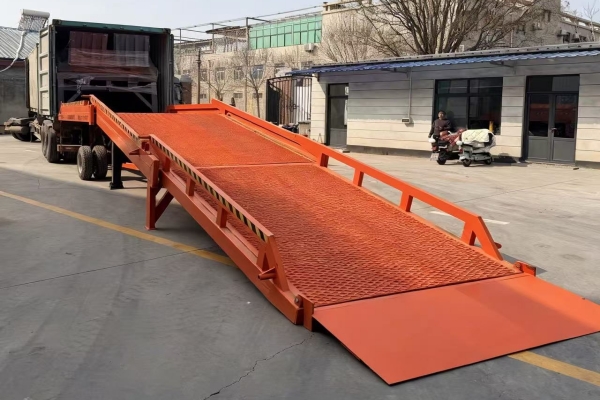
2. Five Core Advantages of Portable Loading Ramps
2.1 No Civil Construction Required, Ideal for Dock-Free Factories (Core Highlight of Portable Container Ramps)
Traditional fixed loading docks require foundation excavation and concrete pouring, costing tens of thousands of US dollars per site with a 15–30 day construction cycle. In contrast, loading dock ramps come with traction wheels. They can be put into service right after placement on flat hardened ground without any construction work.
Small export factories and temporary logistics warehouses can set up multiple loading points flexibly. One portable container ramp can serve several containers in rotation to maximize space utilization.
2.2 Hydraulic Height Adjustment, Compatible with All Standard Containers & Freight Vehicles
Most loading ramps feature an adjustable height range of 1100mm–1700mm, perfectly fitting the chassis height of 20GP and 40GP sea containers, as well as light box trucks and heavy semi-trailers. Operators can lift or lower the ramp deck via a single hydraulic handle to eliminate height gaps between ground and containers. This enables smooth forklift passage and avoids pallet tilting or cargo collision damage — a key technical edge over simple fixed steel planks.
2.3 Heavy-Duty Durable Structure for All-Weather Outdoor Operation
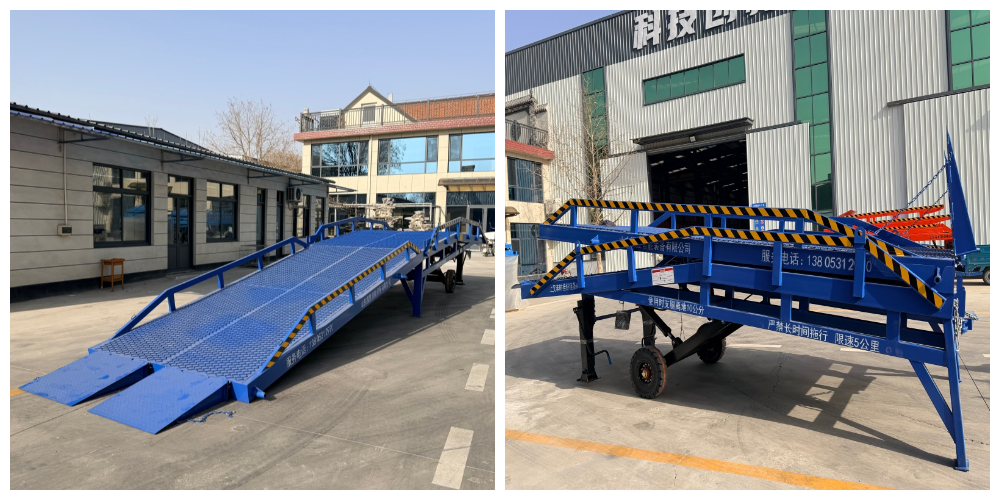
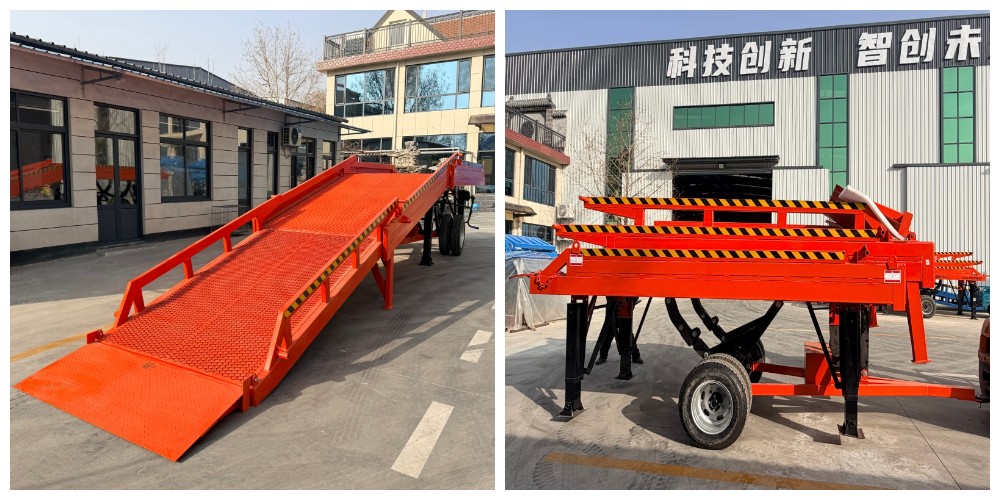
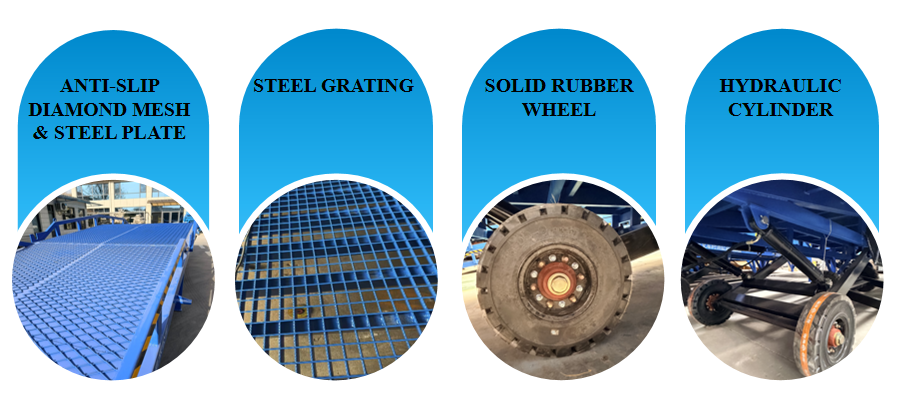
The whole ramp is welded with Q235 main beams. Models rated 6–20 tons reserve a 20% safety load margin to support fully loaded forklifts in motion. The diamond anti-slip grating deck prevents skidding in rainy and humid environments. For coastal high-salt-spray and tropical rainy regions, full hot-dip galvanizing customization is available, delivering 8 years of outdoor service without severe rust and extending the service life greatly.
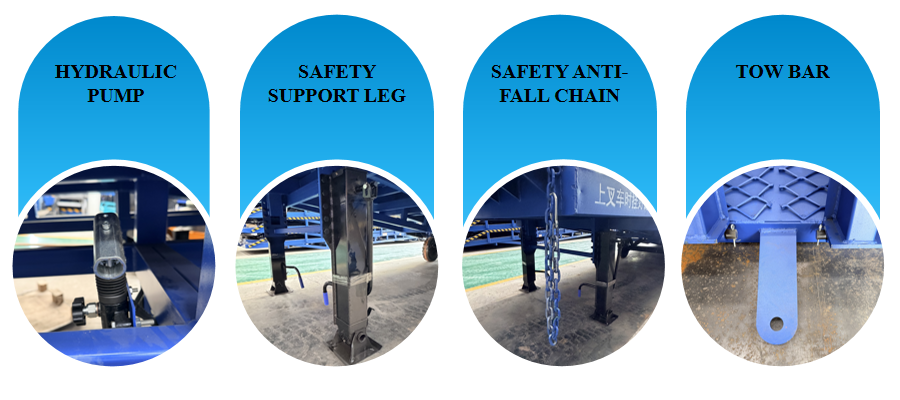
A full set of safety accessories including side guardrails, container locking safety chains and bottom support legs keeps the ramp stable during operation, complying with EU CE safety standards.
2.4 Mobile & Flexible Deployment, Shared Across Multiple Sites to Cut Procurement Costs
Portable container ramps are fitted with solid traction wheels and forklift draw slots, enabling relocation by one worker or a small forklift. A single loading dock ramp can be shared among multiple loading zones within one plant or temporary yards across branch facilities, removing the need to purchase fixed equipment for every station.
For export exhibitions and short-term cargo transit yards, portable loading ramps can be rented or purchased and towed to storage corners after use without occupying core passage space.
2.5 Simple Maintenance, Lower Long-Term Operating Costs
Loading ramps adopt a streamlined hydraulic system that only requires periodic hydraulic oil top-ups and bolt tightening, with no fragile complex electronic control parts. Unlike fixed loading docks, there are no repair costs for cracked concrete or flooded pits. Overseas small buyers report that under equivalent handling volumes, the annual maintenance cost of a portable container ramp is only 1/5 of that of permanent dock equipment, offering outstanding long-term economic benefits.
3. Full-Scene Application of Loading Ramps, Portable Container Ramps & Loading Dock Ramps
3.1 Import & Export Manufacturing Plants (Largest Overseas Buyer Group)
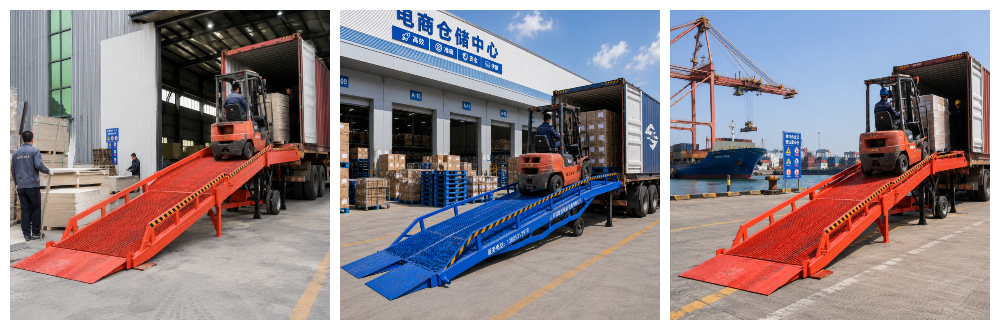
Auto parts, plastic, food machinery and furniture export factories are primary purchasers of loading dock ramps. Most production workshops are built without fixed loading docks for mass finished goods containerization.
6–10 ton portable container ramps match 4-ton internal combustion forklifts widely used in factories, allowing full pallet loading directly into containers and replacing manual handling to double or triple daily container throughput. Heavy machinery processing plants select 12–20 ton heavy-duty loading ramps to transfer large mechanical components with fully loaded heavy forklifts.
3.2 Cross-Border E-Commerce & Third-Party Logistics Warehouses
Overseas e-commerce fulfillment centers and freight forwarding transit yards experience frequent container movements with variable parking positions. Portable container ramps can be towed to any container bay on demand. For LCL consolidation warehouses, one loading ramp can rotate between multiple consolidation containers to resolve space shortages during simultaneous loading.
Temporary warehouses near ports in Bangkok, Manila and other Southeast Asian hubs widely order hot-dip galvanized loading ramps to withstand hot, rainy outdoor conditions.
3.3 Agriculture & Fresh Produce Processing Industry
Fruit & vegetable processing plants and grain warehouses receive bulk farm goods daily and ship finished refrigerated containers to market, with scattered loading zones that fixed docks cannot cover. Lightweight 8-ton loading dock ramps are easy for regular factory staff to lift and move. The anti-slip deck prevents fresh produce pallets from sliding and breaking, cutting fruit and vegetable loss. Demand remains strong among agricultural distributors in North America and Thailand.
3.4 Temporary Construction Projects, Exhibitions & Used Machinery Markets
Construction site equipment transfer, overseas exhibition material handling and second-hand machinery trading yards lack permanent loading infrastructure, making portable container ramps a cost-effective temporary loading solution. Construction sites frequently relocate work zones, and the traction wheel design eliminates repeated infrastructure investment.
3.5 Auxiliary Temporary Yards at Seaports
Private storage yards surrounding major ports including Laem Chabang, Manila and Los Angeles see frequent short-term container storage and turnover. Mass volumes of loading ramps are purchased as supplementary loading equipment to offset insufficient permanent port dock berths and ease container queuing congestion.
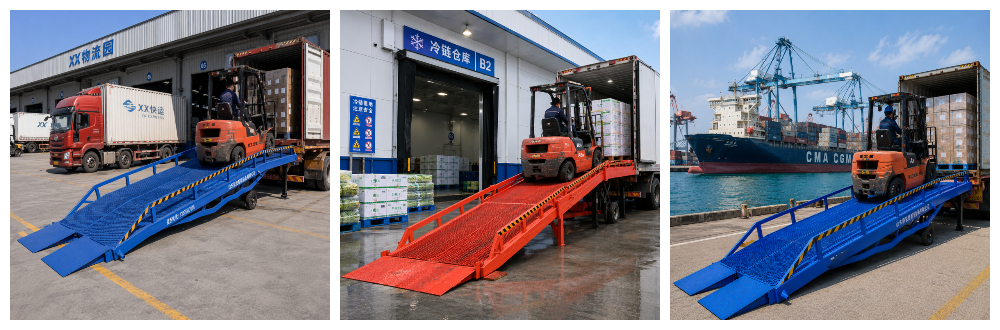
4. Simplified Manufacturing Process of Portable Loading Ramps (Reference for Foreign Buyers)
Production of mainstream loading ramps and portable container ramps follows standardized procedures for factory audit and quality verification by purchasers:
1.Steel Cutting: CNC cutting for Q235 manganese steel main beams and anti-slip grating with dimensional tolerance ≤2mm
2.Welding Forming: Robotic full welding for the main frame to eliminate gaps and guarantee anti-deformation performance under heavy loads
3.Surface Anti-Corrosion Treatment: Standard models with shot blasting + electrostatic powder coating; coastal customized versions with full hot-dip
4.galvanizing、Hydraulic System Assembly: Domestic or imported hydraulic cylinders and manual power stations installed, followed by lifting performance testing
5.Safety Fitting Assembly: Complete installation of guardrails, locking chains, support legs and traction wheels
6.Load Pressure Testing: Every ramp undergoes 24-hour static testing under 125% of rated load; only units with zero deformation or oil leakage are cleared for shipment
7.Quality Inspection & Packing: Shipped with CE certificates, material test reports and operation manuals
5. Frequently Asked Questions from Global B2B Buyers
Q1: What is the difference between loading ramp, portable container ramp and loading dock ramp?
A: All three terms refer to the same product with different naming focuses. "Loading ramp" is the general universal name for mobile loading equipment. "Portable container ramp" highlights lightweight models specially built for container handling. "Loading dock ramp" describes mobile levelers that replicate fixed dock functionality, featuring longer hydraulic stroke and higher load capacity. The three terms are interchangeable in daily foreign trade communication.
Q2: Can a portable container ramp be used on unpaved muddy ground overseas?
A: Direct use on soft mud ground is not recommended, as heavy loads may cause sinking and tilting. You can lay steel plates or gravel to create a simple hardened base, or select models with widened load-bearing bases to distribute weight evenly and ensure safe operation.
Q3: How to select the correct load capacity of a loading ramp matching factory forklift tonnage?
A: Selection formula: Ramp rated load ≥ forklift self-weight + weight of fully loaded goods. For a mainstream overseas 4-ton forklift carrying 2 tons of cargo (total 6 tons), a minimum 6-ton portable container ramp is required. If you frequently transfer heavy machinery pallets, upgrade the capacity by 2 tons for extra safety margin and opt for 10-ton or 15-ton loading dock ramps.
Q4: What custom configurations are required for portable container ramps exported to hot, rainy Southeast Asian regions?
A:
Full hot-dip galvanizing anti-corrosion finish instead of standard powder coating
Waterproof dustproof protective cover for hydraulic power units
Thickened anti-slip grating with drainage holes
Stainless steel locking chains to avoid rust jamming caused by rainwater

6. Conclusion & Call to Action for Buyers
Against the backdrop of global logistics industry growth, loading ramps, portable container ramps and loading dock ramps have become cost-saving, efficiency-boosting essential equipment for dock-free export factories and logistics warehouses. Their mobility, zero construction cost and multi-scenario compatibility help mobile loading ramps continuously capture market share from traditional fixed docks.
If you are a procurement manager for overseas warehouses, manufacturing plants or freight forwarding companies searching for portable container ramps matching local container and forklift operating conditions, feel free to contact us. Provide your yard dimensions, forklift tonnage and target export country, and we will supply a customized loading dock ramp selection plan, full technical data sheet and CIF port quotation free of charge.
Customization of anti-corrosion treatment, deck width and load capacity is available on demand. We provide a full set of CE customs clearance documents to guarantee smooth customs clearance in your local market.