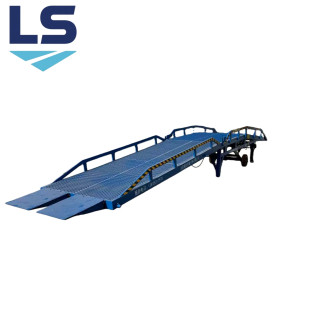
High Quality Mobile Ramp
1.Superior Mobility & Quick Deployment
Two-section folding for compact storage, with heavy-duty casters and traction hooks for fast relocation and quick unfolding & locking for on-demand use.
2.Robust Load Capacity & Stable Operation
High-strength thickened manganese steel frame, reinforced support legs, stable full-load operation without shaking, smooth hydraulic lifting.
3.Broad Compatibility & Strong Adaptability
Stepless height adjustment for all mainstream trucks and containers, anti-corrosion treated for stable work in indoor and outdoor complex environments.
4.Cost-Effectiveness & Low Maintenance
Lower investment than fixed docks, no civil construction needed; brand core parts and simple structure, only regular lubrication for easy maintenance.
5.Comprehensive Safety Protection
Product Introduction
The High Quality Mobile Ramp is a heavy-duty platformless loading and unloading equipment designed for large-tonnage and high-frequency loading and unloading scenarios. It is made of an integral welded manganese steel structure, discarding the segmented folding design, which fundamentally enhances the overall load-bearing capacity and anti-deformation ability of the bridge body. It is equipped with a precise hydraulic lifting system and an anti-slip and wear-resistant bridge deck, which can flexibly adapt to the height of the cargo compartments of heavy-duty trucks and containers of different tonnages. Achieve seamless integration. The equipment is equipped with heavy-duty mobile wheelsets and traction devices, making it flexible for relocation and easy to move. It does not require professional construction or installation. After being leveled on site, it can be put into use immediately. Moreover, it has a simple structure with a low failure rate and is convenient for daily maintenance. It is widely applicable to the loading and unloading of heavy goods in scenarios such as port freight stations, heavy industry factories, and large logistics parks, significantly improving operational efficiency and reducing labor and equipment operation costs.
1.Integral seamless steel structure, formed by one-piece welding, with no weak points in splicing. It is more resistant to deformation and durable for large-tonnage operations
2.The wide and thickened anti-slip bridge deck has a large contact area, is anti-slip and anti-side-slip, ensuring the safety of heavy goods and forklifts when passing through.
3.Precise hydraulic lifting system, smooth height adjustment, suitable for various large vehicle models such as heavy-duty trucks and containers.
4. Heavy-duty solid wheel set + powerful traction structure, stable movement, fast transfer, flexible scheduling at multiple operation points without pressure There are no complex assembly steps.
5 .The operation can be started immediately after landing and leveling. It is easy to operate and only requires basic lubrication and maintenance on a daily basis, which is worry-free and labor-saving

Product Parameters
External dimensions | Expansion dimensions: 11400mm (length) x 2100mm (width) x 1500mm (height) |
Platform size | Slope length (mm): 7200 ,Tail board (mm): 86mm, Front tongue plate(mm): 400mm, Equipment interior width: 2100mm, covered with 4mm steel plate and 6mm steel plate mesh |
Rated load capacity | 10000KG |
Equipped with power | Manual hydraulic pump, 2 hand cranked legs |
Adjustment range | 1100-1800mm (equipment adjustment range) |
Guardrail height | 300mm (40 x 80 x 3mm rectangular tube) |
Main structure | 160 x 80 x 4 rectangular tube 120 x 60 x 4 rectangular tube 5 main beams (with a spacing of about 40cm between the cross braces) |
Secondary beam structure | 100 x 50 x 4mm rectangular tube |
Hydraulic cylinder | Φ 80 x Φ 45 (2 pieces) |
Hydraulic tubing | 32Mpa high-pressure oil pipe |
Mobile rubber wheels | 600-9 solid tire |
Bridge and Container | The bridge body is welded with hooks and fixed with steel chains |
Paint surface | Blue (Qilu Acrylic Resin Paint) |
Product Classification
1.Classified by rated load capacity: heavy-duty type (10-15 tons), super-heavy-duty type (16-20 tons), precisely matching the loading and unloading demands of medium and small-tonnage heavy freight, large containers/heavy-duty trailers with large tonnage.
2. Classified by bridge deck specifications: standard width type, widened and lengthened type, suitable for different loading and unloading scenarios such as the passage of regular forklifts and the simultaneous operation of large forklifts or multiple forklifts.
3. Classified by operation scenarios: indoor warehousing model, outdoor freight model. The outdoor model has been upgraded with full-vehicle anti-rust and anti-corrosion processes and waterproof hydraulic components, making it suitable for complex open-air working conditions in ports and freight stations
Working Principle
1.Load-bearing support principle: It adopts an integral manganese steel welded structure to form a uniform force-bearing frame throughout the entire area. The pressure of the goods and forklifts is directly transmitted to the bottom support structure and the ground through the bridge deck. It is equipped with adjustable load-bearing legs for ground locking, ensuring no deformation or shaking during large-tonnage operations, and enhancing the overall impact resistance.
2. Height adjustment principle: The hydraulic power system drives the main cylinder to extend and contract, thereby lifting and lowering the front end of the loading bridge. The height is precisely controlled and adjusted through the hydraulic pump station, which can flexibly match the height of the cargo compartments of heavy-duty trucks and container trailers of different tonnages, achieving the construction of seamless loading and unloading channels between trucks and the ground, and meeting the docking requirements of various large vehicle types.
3. Mobile traction principle: The bottom of the bridge body is equipped with heavy-duty solid wheel sets and dedicated traction hooks. Before operation, the equipment can be moved by traction equipment or manual push. The wheel body is adapted to heavy-load scenarios for smooth movement. After being moved to the operation point, the load-bearing outriggers are lowered and the wheels are locked to fix the equipment at the operation position, ensuring overall stability and no displacement during loading and unloading.
Product Application
1.Port freight stations/logistics hubs: Suitable for handling large-tonnage goods such as containers and heavy-duty trailers, seamlessly connecting with various freight trucks, and enhancing the operational efficiency of port cargo transshipment and short-distance transfer.
2. Heavy Industry Manufacturing plant area: It meets the loading, unloading and transportation requirements of large equipment and heavy components, ADAPTS to the dispatching of multiple operation points within the plant area, and conforms to the material transportation rhythm of heavy industry production.
3. Large-scale logistics parks/freight distribution centers: For the loading and unloading scenarios of large-tonnage full truckload goods, there is no need for fixed platforms. They can be flexibly allocated to different loading and unloading areas, and are suitable for high-frequency and multi-vehicle freight operations.
4. Mine/Building Materials Storage base: Suitable for batch loading and unloading of heavy building materials such as ores, steel, and cement. Its impact-resistant and wear-resistant features are in line with the rough outdoor working environment, ensuring the safe and efficient transfer of heavy goods
Company Strengths

Our company has been deeply engaged in the research and development and manufacturing of integrated mobile loading Bridges for many years, focusing on creating high-quality heavy-duty loading and unloading equipment. Our core advantages are concentrated on three aspects: overall structure optimization, heavy-duty load-bearing upgrade, and full-scenario adaptation. The product is made of thickened manganese steel in accordance with national standards and formed by integral welding. There are no weak points in the splicing. After professional mechanical calculation and full-load compressive strength test, the anti-deformation and anti-impact performance of the bridge body far exceed the industry standards. It is equipped with the brand's original large-displacement hydraulic system, with precise and smooth height adjustment, suitable for long-term and high-frequency operation of large-tonnage goods. As an original manufacturer, we can customize bridge deck specifications, load grades and towing methods based on customers' personalized requirements such as operation scenarios, load demands and vehicle model compatibility. Factory direct supply without any middleman price difference, featuring both high cost performance and fast delivery advantages. At the same time, we are equipped with a dedicated technical service team, providing free on-site survey, customized loading and unloading solution design, as well as one-stop services including on-site installation and commissioning, operation training, etc. Our after-sales service network covering the whole country can achieve rapid response. We offer direct delivery of regular consumable parts in stock and provide lifetime technical guidance and equipment maintenance support. With solid product quality, customized solutions and considerate full-cycle services, we safeguard heavy loading and unloading operations in industries such as ports, heavy industry and logistics.
FAQ
1.The integrated loading bridge is relatively heavy and difficult to push manually. How can it be flexibly moved?
The equipment is standardly equipped with a dedicated traction hook, which can be directly connected to forklifts, trailers and other traction equipment to achieve rapid relocation. If short-distance fine-tuning is required, a crowbar can be used in conjunction with the force point at the bottom of the bridge to gently push. At the same time, ensure that the wheel set is not stuck and regularly add lubricating oil to improve the smoothness of movement.
2.After long-term heavy-tonnage operations, if the bridge deck shows slight wear and tear, does it affect its use and how should it be handled?
Minor surface wear does not affect the core's load-bearing capacity and usage. The worn areas can be promptly ground to remove rust and then coated with wear-resistant and anti-rust paint. If the wear is so severe that the base steel is exposed, a thickened wear-resistant layer should be welded and anti-slip treatment should be carried out. In daily operations, anti-slip MATS can be laid in high-frequency traffic areas to reduce wear.
3.When the front end of the bridge body gets stuck and the lifting is not smooth during hydraulic lifting, how can it be investigated and solved?
First, check if the hydraulic oil is insufficient or turbid. Replenish the original factory-specific hydraulic oil and replace the filter element. Check again whether air has entered the cylinder and open the air release valve to expel the air. Finally, check whether the hydraulic pipelines are bent and whether the joints are leaking oil. Clear the pipelines and tighten the leaking joints, and the smooth lifting and lowering can be restored.
4.After outdoor use, if rust and jamming occur at the bottom of the axle body and the wheel set, how should it be dealt with and prevented?
First, grind and remove the rust from the rusted areas. Spray anti-rust primer and topcoat on the metal parts. Add high-temperature grease to the wheel set bearings to relieve jamming. Daily prevention requires regular cleaning of accumulated dust and water at the bottom of the equipment. Apply anti-rust grease to metal parts such as wheel sets and traction hooks every month. When not in operation, cover them with waterproof and dustproof covers.
5.When there is a gap at the junction of the bridge and the truck body during operation, which can easily cause the forklift to jolt, how should it be adjusted?
First, precisely adjust the height of the bridge deck through the fine-tuning outriggers on both sides of the bridge body to make the connection point flush. If the truck compartment is tilted, anti-slip pads can be added to the corresponding side of the bridge body. At the same time, tighten the handbrake of the truck and fix the wheels with triangular timbers to prevent the cargo compartment from shifting and creating gaps, ensuring the smooth passage of the forklift.