
Transfer Trolley Cost
1. Exceptional Load-Bearing Capacity for Heavy-Duty Applications
Robust steel frame supports heavy loads from 5 to 200+ tons, ensuring stable, reliable transport for molds, steel, and heavy machinery in demanding industrial settings.
2. Flexible Mobility & Maneuverability
Supports single/dual/curved rails with tight turning radii. Variable speed control and wireless remote enable smooth, precise movement in complex workshop layouts.
3. Enhanced Safety for Workplace Operations
Dual braking, anti-collision sensors, limit switches, and overload/emergency stop protection deliver comprehensive safety, reducing workplace accidents and ensuring compliance.
4. Cost-Effective & Low Maintenance
Electric power cuts fuel costs and emissions. Durable design requires only basic inspections and lubrication, minimizing downtime and long-term ownership expenses.
Product Introductio
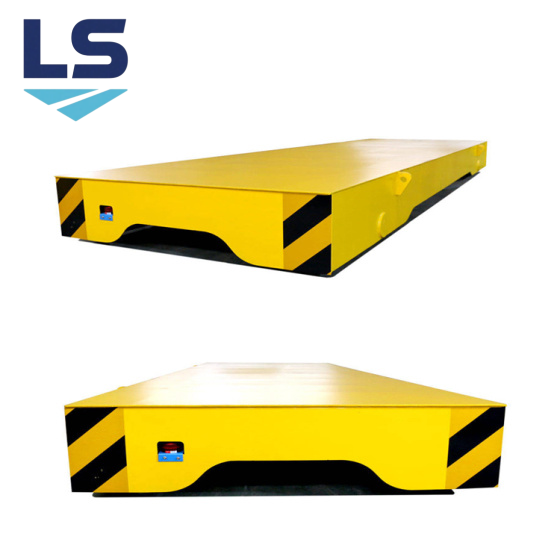
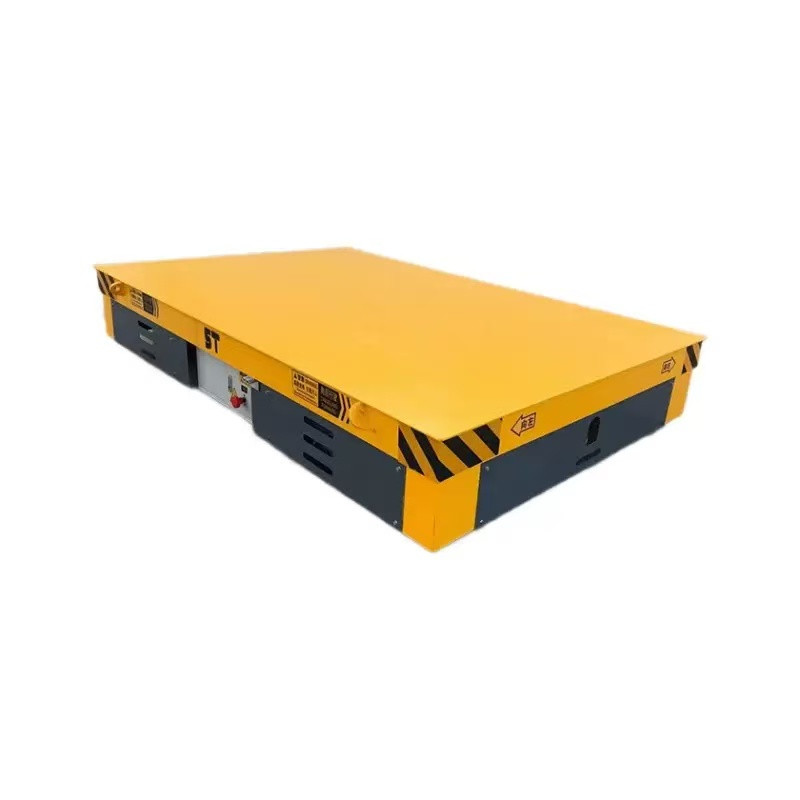
The electric track flat car is a heavy-duty rail-mounted electric transfer equipment specially designed for scenarios such as factory workshops, warehousing and logistics, metallurgy and heavy industry, etc. It is powered by electricity and runs smoothly along a fixed track. It can efficiently carry heavy materials ranging from 5 tons to hundreds of tons (such as molds, steel, large equipment, castings, etc.), replacing traditional manual and inefficient handling methods. It features high load capacity, high safety, low energy consumption and easy maintenance, and supports customized design and automated integration. It is a core equipment for material handling in modern industrial production
1.Strong heavy-load capacity: The high-strength steel welded frame is adopted, with a wide range of rated load repeat covers, which can meet the stable transportation of various heavy and super-heavy materials, and will not deform under long-term heavy loads.
2. Flexible and precise operation: Compatible with various track forms such as single-track, double-track, and curved track, supports stepless speed regulation and precise positioning, can achieve small-radius turns, and is suitable for complex workshop layouts.
3. Comprehensive safety protection: Equipped with dual braking systems, anti-collision sensors, limit devices and electrical overload protection, multiple safety mechanisms eliminate potential safety hazards such as derailment, collision and overloading.
4. Economical, durable and easy to maintain: Electric drive has no exhaust gas and low energy consumption. The core components are highly reliable. Only basic inspection and lubrication are required on a daily basis, significantly reducing usage and maintenance costs.
5. Customization and automation compatibility: The size, tabletop, and power supply method can be customized according to industry requirements. It supports integration with systems such as MES and WMS to achieve unmanned automatic transfer.

Product Classification
1.Classified by power supply mode: it is divided into battery-powered type, low-voltage track power supply type, and cable drum power supply type, which are respectively suitable for short-distance independent operation, long-distance continuous operation, and short-distance transfer scenarios along fixed routes.
2. Classified by the form of the running track: It is divided into double-track electric flat cars, single-track electric flat cars, and curved track/turning type electric flat cars, meeting the layout requirements of different site Spaces and driving routes.
3. Classified by function and special working conditions: It is divided into standard flat plate type, lifting type, explosion-proof type and high-temperature resistant type, suitable for special operation requirements such as ordinary heavy-load transfer, height connection of workstations, flammable and explosive environments, and high-temperature metallurgy.
Working Principle
1.The principle of power supply and power retrieval is to obtain electrical: energy through means such as batteries, low-voltage tracks, cable rerolls or sliding contact lines. After being stabilized and rectified by the on-board controller (frequency converter/PLC), it provides stable power to the drive motor and control system, ensuring the continuous operation of the flat car.
2. Driving walking principle: The driving motor converts electrical energy into rotational power. After deceleration and torque increase by the reducer, it is transmitted to the wheels through the transmission shaft, enabling the flat car to travel smoothly along the fixed track. By controlling the forward and reverse rotation and rotational speed of the motor, forward, backward, speed regulation and precise start and stop can be achieved.
3. Control and Safety Principles: The operator issues instructions through the remote control or operation panel, and the controller receives and executes the actions. At the same time, through limit switches, anti-collision sensors, emergency stop buttons, overload/under-voltage protection and other devices, automatic shutdown and alarm for abnormal situations such as over-travel, collision and overloading are achieved to ensure operational safety
FAQ
1.Question: For long-distance transportation (over 50 meters), which power supply type of flatcar should be preferred?
Answer: Give priority to low-voltage track or sliding contact line power supply types to avoid problems such as insufficient battery life and limited cable length in the cable drum.
2.Question: What protective measures should be taken when using electric track flatcars in damp environments?
Answer: Waterproof sealing treatment should be carried out on electrical components. Waterproof controllers and motors should be selected. Regularly dry the circuit joints to prevent short circuits and moisture.
3.Question: Is it normal for a flatcar to still slide slightly after braking?
Answer: Abnormal, mostly due to worn brake pads or excessive braking clearance. It is necessary to replace the brake pads in time and adjust the braking device clearance to avoid potential safety hazards.
4.Question: The low-voltage rail-powered flat car has unstable power supply and frequent power outages. How to maintain it?
Answer: Clean the debris and oxide layer on the surface of the track, check the wear of the power extraction carbon brushes, replace the worn carbon brushes and adjust the contact pressure, and do a good job in the insulation protection of the track.
5.Question: The vehicle's display screen reports an error and the flatbed car cannot start. How should I deal with it?
Answer: Locate the fault (such as under-voltage, overload, sensor abnormality) by referring to the error code in the manual, and then check the battery, load or sensor specifically. Reset and try again.