How to Choose the Right Mobile Loading Ramp: A Complete Buying Guide
How to Choose the Right Mobile Loading Ramp | Buying Guide for Warehouse & Forklift Ramp
For B2B buyers: Learn tips for mobile loading ramp selection, specs, trends & safety standards. Pick ideal warehouse, forklift and container loading ramp easily.
1.Industry Background: Why Mobile Loading Ramps Are Logistics Essentials
With the rapid expansion of global cross-border e-commerce and warehousing logistics, cargo turnover keeps rising steadily. A loading and unloading ramp has become core equipment connecting warehouses, trucks and shipping containers. Traditional fixed loading docks come with high renovation costs and poor flexibility, making them unsuitable for small and medium-sized factories, temporary yards and multi-site container operations. For this reason, the market demand for mobile loading ramp, warehouse loading ramp, forklift loading ramp and container loading ramp has grown rapidly.
Statistics show that the global mobile loading ramp market reached approximately 1.5 billion US dollars in 2024, and is projected to hit 2.5 billion US dollars by 2033, with a compound annual growth rate of 6.1%. The Asia-Pacific region sees the fastest growth. As a major manufacturing and exporting country, China accounts for over 28% of global sales. For international B2B buyers, a well-selected mobile loading ramp can boost loading and unloading efficiency by more than 30%, while effectively cutting labor costs and equipment wear.

2. Main Product Types: How to Select Warehouse, Forklift and Container Loading Ramps
Many buyers get confused by different ramp models. In fact, warehouse loading ramp, forklift loading ramp and container loading ramp differ greatly in structure, load capacity and applicable scenarios.
2.1 Warehouse Loading Ramp
Designed for high-frequency daily operations inside fixed warehouses, it features a solid structure and excellent anti-slip performance, ideal for regular truck loading and unloading. Its standard deck width ranges from 1.8 meters to 2.3 meters, with a common length of 11 meters. It works perfectly for light and medium loads and frequent start-and-stop operations.

2.2 Forklift Loading Ramp
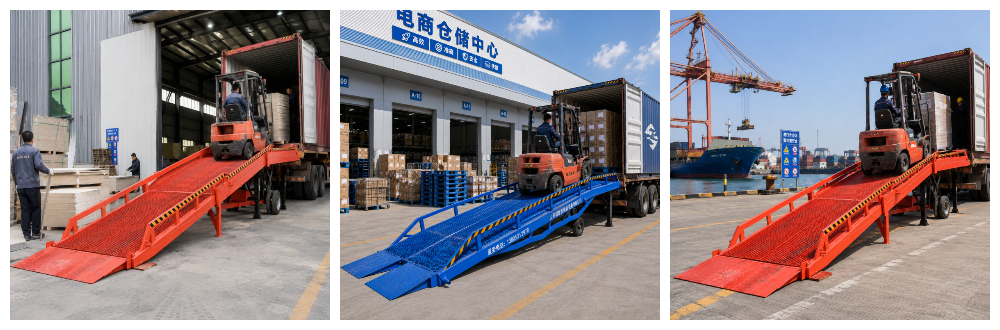
Reinforced on main beams and deck surfaces, this type resists impact and deformation, specially built for fully loaded forklifts travelling up and down slopes. Its load capacity ranges from 6 tons to 15 tons, among which the 10-ton model is the most popular, taking up around 35% of the market. A qualified forklift loading ramp must stay free of dents even when a forklift passes through at 10 km/h, with sufficient safety margin reserved.
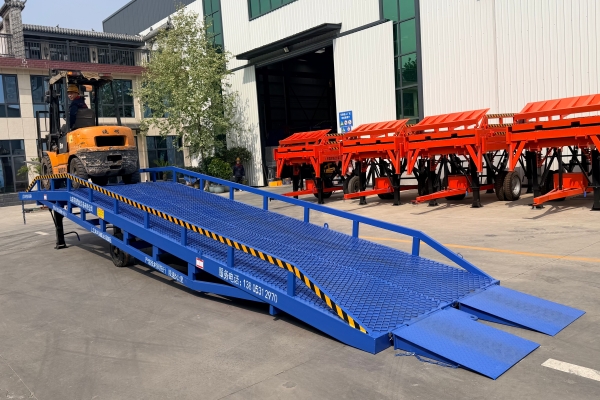
2.3 Container Loading Ramp
It boasts a wide height adjustment range from 1.1 meters to 1.7 meters and a gentler gradient, matching the floor height of standard shipping containers. Most container loading ramp models are 11 meters long. The mild slope reduces the climbing angle for forklifts, protecting vehicle chassis and ensuring operational safety.
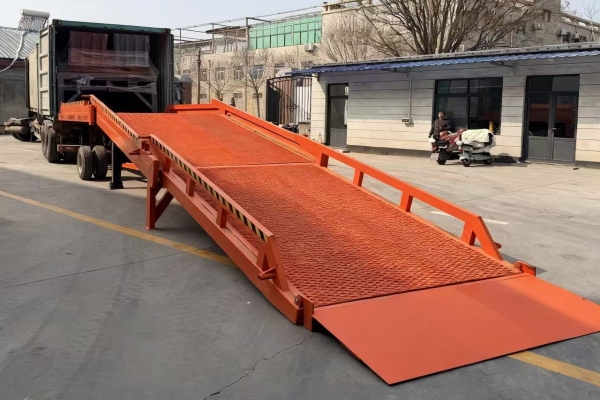
2.4 Mobile Loading Ramp
Equipped with solid rubber tires and a towing hook, it requires no civil construction and can be relocated freely. It is the top choice for temporary yards and multi-site operations. Supported by hydraulic lifting system, it adapts to height differences of various vehicles.

3. Core Technical Specifications: Key Indicators for B2B Buyers
Price should not be the only consideration when purchasing a loading and unloading ramp. The following specifications directly determine equipment safety and service life.
3.1 Rated Load Capacity (The Most Critical Factor)
Common load ratings of forklift loading ramp include 6T, 8T, 10T, 12T and 15T. Follow this selection rule: the rated load of the ramp shall be greater than the total weight of the forklift plus cargo, with an extra 20% safety margin. Long-term overloading will shorten the equipment service life by more than 40%.
3.2 Material & Manufacturing Technology
Premium mobile loading ramp adopts high-strength manganese steel for main beams, paired with anti-slip patterned steel or grating decks, delivering strong resistance to bending, torsion and corrosion. All welding work complies with GB/T 12467 standards, and key welds are inspected via flaw detection.
3.3 Hydraulic System & Safety Features
Integrated hydraulic pump station ensures smooth lifting and reliable pressure holding.
Standard configuration includes anti-slip plates, safety support legs and anti-fall devices.
Overload protection accuracy is within 5%, and the unit will trigger alarms and stop automatically in case of abnormalities.


4. Industry Trends in 2025: Electrification, Lightweight Design & Customization
The global loading ramp market presents three major trends:
Popularization of hydraulic systems: More than 53% of newly built warehouses choose hydraulic mobile loading ramp for easy operation and precise height adjustment.
Rising demand for heavy-duty models: 72% of large and medium-sized warehouses are equipped with forklift loading ramp. Forklifts can drive directly into containers, lifting overall efficiency by 50%.
Growing demand for customization: Orders of special container loading ramp for cold storage, explosion-proof environments and narrow spaces have increased by 15.6%.
5. Frequently Asked Questions
Q1: Does a mobile loading ramp require fixed installation?
A: No. The mobile loading ramp needs no civil construction and is ready for use upon arrival. It can be towed and moved easily, which makes it ideal for sites without fixed docks and temporary work areas. It is far more flexible than fixed loading ramps.
Q2: Can a warehouse loading ramp be used outdoors all year round?
A: Yes. Standard products go through rust removal, anti-corrosion treatment and multi-layer painting, capable of withstanding humid, rainy and sunny outdoor conditions. Daily maintenance is simple: just check hydraulic oil and welds regularly.
Q3: Can a container loading ramp replace a forklift loading ramp, and vice versa?
A: It is not recommended. A container loading ramp is longer with a gentler slope, while a forklift loading ramp features a stronger structure and better impact resistance. Do not mix their use in heavy-duty and high-frequency scenarios to avoid structural deformation and potential safety hazards.
6. Summary & Purchasing Advice (CTA)
When selecting mobile loading ramp, warehouse loading ramp, forklift loading ramp and container loading ramp, prioritize scenario matching, sufficient load margin, reliable workmanship and complete safety configurations. Never chase low prices blindly. Low-cost products usually come with cut corners and insufficient safety factors, which will cost you more in the long run.
If you are looking for reliable loading and unloading ramp solutions for your warehouse, yard or container handling projects, we supply a full range of mobile loading ramp, forklift loading ramp and container loading ramp with load capacities from 6 tons to 15 tons. Custom sizes and special configurations are available. All products undergo strict factory tests and meet international safety standards.
Feel free to contact us for professional one-on-one selection advice and accurate quotations. Let’s make your loading and unloading work safer, more efficient and worry-free!