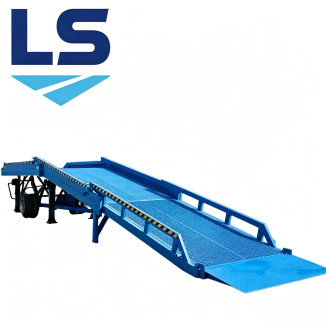
High Mobile Ramp Quality
1.High Flexibility and Mobility
Equipped with heavy-duty load-bearing wheels and traction hook, enabling smooth traction/pushing relocation. No complex installation, quick positioning and immediate use for flexible multi-point operation.
2.Comprehensive Safety Performance
Thickened anti-slip deck, reinforced anti-sinking support legs and brake wheels, with overload protection. Integral welded structure ensures no shaking/deformation under heavy load for all-round safety.
3.Improved Operational Efficiency
Precise hydraulic height adjustment for seamless docking with heavy trucks and containers. Wide thickened deck allows smooth forklift passage, realizing fast large-tonnage cargo loading and unloading.
4.Low Maintenance Cost & Durability
One-piece welded high-strength manganese steel structure, wear and impact resistant. Brand core hydraulic parts, few fault points, only regular lubrication for low daily maintenance cost.
Product Introduction
The High Mobile Ramp Quality is a dedicated equipment without a platform, specially designed for the loading and unloading of heavy goods. It adopts an integral all-steel structure and is forged in one piece. The core hydraulic system precisely controls the speed for lifting and lowering, which can quickly connect with various heavy-duty trucks and containers, and is suitable for direct passage and operation of forklifts. The equipment is equipped with heavy-duty mobile wheelsets and traction devices, requiring no infrastructure construction and ready for immediate use upon landing. It features core advantages such as strong load-bearing capacity, high stability, and easy mobility. The entire vehicle has undergone wear-resistant and anti-corrosion treatment, making it suitable for large-tonnage and high-frequency loading and unloading scenarios both indoors and outdoors, such as ports, factories, and logistics parks. This fundamentally enhances the efficiency of heavy cargo transfer and reduces labor and site operation costs.
1.The entire structure is made of all-steel, with no seams at the joints, strong load-bearing capacity, and no deformation during large-tonnage operations
2.Precise hydraulic lifting, wide height adjustment range, quick connection with heavy-duty trucks and containers
3.Heavy-duty wear-resistant wheel set + traction hook, flexible movement, easy dispatch and transfer to multiple operation points.
4. No installation or infrastructure construction is required. Just level the ground and it's ready for operation. The operation is simple and significantly reduces construction costs. The entire vehicle is treated for wear resistance and corrosion resistance, with a streamlined structure and a low failure rate. Daily maintenance is convenient and worry-free

Product Parameters
External dimensions | Expansion dimensions: 11400mm (length) x 2100mm (width) x 1500mm (height) |
Platform size | Slope length (mm): 7200 ,Tail board (mm): 86mm, Front tongue plate(mm): 400mm, Equipment interior width: 2100mm, covered with 4mm steel plate and 6mm steel plate mesh |
Rated load capacity | 10000KG |
Equipped with power | Manual hydraulic pump, 2 hand cranked legs |
Adjustment range | 1100-1800mm (equipment adjustment range) |
Guardrail height | 300mm (40 x 80 x 3mm rectangular tube) |
Main structure | 160 x 80 x 4 rectangular tube 120 x 60 x 4 rectangular tube 5 main beams (with a spacing of about 40cm between the cross braces) |
Secondary beam structure | 100 x 50 x 4mm rectangular tube |
Hydraulic cylinder | Φ 80 x Φ 45 (2 pieces) |
Hydraulic tubing | 32Mpa high-pressure oil pipe |
Mobile rubber wheels | 600-9 solid tire |
Bridge and Container | The bridge body is welded with hooks and fixed with steel chains |
Paint surface | Blue (Qilu Acrylic Resin Paint) |
Product Classification
1.Classified by the type of vehicle suitable for the operation: truck-specific models and container-specific models. The truck-specific models are suitable for various heavy-duty box and flatbed trucks, while the container-specific models optimize the bridge deck height and docking Angle to meet the loading and unloading requirements of standard container trailers.
2. Classified by power configuration: pure manual model, electric and manual dual-purpose model. The pure manual model has no power dependence and is suitable for remote freight points and temporary operations. The electric and manual dual-purpose model can be used for high-frequency electric operations and manual emergency leveling, with stronger scene adaptability.
3. Classified by wheel set configuration: solid rubber wheel models and polyurethane wheel models. Solid rubber wheels are wear-resistant and durable, suitable for rough outdoor ground. Polyurethane wheels are quiet and smooth, suitable for equipment relocation in indoor warehouses or leveled factory areas.
4. Classified by functional adaptation: Basic general-purpose model and multi-functional enhanced model. The basic model is suitable for regular large-tonnage loading and unloading, while the enhanced model is equipped with an anti-slip reinforced bridge deck and dual hydraulic cylinders, making it suitable for harsh working conditions and ultra-high-frequency operations.
Working Principle
1.Overall load-bearing principle: High-strength manganese steel is welded into an integrated load-bearing frame, which evenly transmits the heavy pressure of forklifts and goods to the entire bridge body and the ground. It is equipped with adjustable load-bearing outriggers for ground locking, distributing local forces to ensure no deformation or shaking during heavy-load operations and guaranteeing structural stability.
2. Hydraulic lifting principle: The hydraulic pump station drives the oil cylinder to extend and contract, which in turn lifts and lowers the front end of the bridge body. The flow of hydraulic oil is adjusted through manual/electric control valves to achieve precise and smooth adjustment of the bridge deck height. It can flexibly match the height of different truck and container carriages to achieve seamless connection.
3. Mobile positioning principle: The bottom of the bridge is equipped with heavy-duty wheel sets and dedicated traction hooks, which can be flexibly moved to multiple operation points through traction equipment or manual push. After reaching the operation position, lower the load-bearing outriggers and lock the wheels to secure the equipment and prevent displacement during loading and unloading.
4. Anti-slip passage principle: The bridge deck is designed with anti-slip patterned steel plates/toothed steel plates to increase the friction with forklift tires and goods. Meanwhile, the connection ends of the bridge body are treated with slope transitions to reduce the jolts during forklift passage, prevent goods from sliding sideways and forklifts from slipping, and ensure the safety of loading and unloading passage.
Product Application
1.Port freight and container hub: Suitable for large-tonnage full container loading and unloading of containers and heavy trailers, seamlessly connected with various freight trucks, efficiently completing heavy loading and unloading operations for port cargo transshipment and short-distance consolidation, and enhancing the turnover efficiency of port freight.
2. Heavy Industry Manufacturing and Equipment Factory Area: It can handle the loading, unloading and transportation of large industrial equipment, heavy components, molds and other heavy objects, adapt to the flexible scheduling of multiple operation points in the factory area, and meet the material transportation needs of the entire heavy industry production process.
3. Large-scale logistics parks and freight distribution centers: In response to the frequent loading and unloading scenarios of large-tonnage full truckload goods, there is no need for fixed platforms. They can be flexibly allocated to different loading and unloading areas to match the operations of multiple vehicle types such as heavy-duty trucks and semi-trailers, thereby enhancing the efficiency of logistics distribution.
4. Building materials/Mining storage and Freight base: Suitable for batch loading and unloading of heavy building materials such as steel, ores, cement, and prefabricated components. Its impact resistance and wear resistance are in line with the rough outdoor working environment, ensuring the safe and efficient transportation of heavy materials. Write a product introduction copy about the integrated loading bridge and recommend some application cases of the integrated loading bridge. What is the market price range of the integrated loading bridge
Company Strengths

Our company has been dedicated to the research and development and production of mobile loading Bridges for many years. We are a source manufacturer integrating independent research and development, customized production, and one-stop supporting services. Our core advantages focus on three dimensions: quality, customization, and service. The product is made of high-strength manganese steel as raw material. The one-piece model is integrally welded to form strong load-bearing capacity, and the folding model has an optimized structure for high flexibility. The core hydraulic system, wheel sets and other components all use original parts from well-known brands. After multiple strict tests, it ensures the equipment is stable under heavy load and durable. The entire series covers multiple load, power and protection process specifications. Factory direct supply eliminates intermediate links. We support personalized customization of bridge deck size, load grade, anti-corrosion process, etc. Fast delivery and high cost performance. At the same time, we offer free on-site survey, customized loading and unloading solution design, on-site installation and commissioning, operation training, and after-sales service with a complete national network, 24-hour rapid response, direct delivery of spare parts in stock, lifetime technical guidance and maintenance support, fully meeting the loading and unloading needs without platforms in various industries such as logistics, ports, heavy industry, and building materials. To ensure efficient operation, cost reduction and efficiency improvement for enterprises
FAQ
1.How can I quickly troubleshoot if the hydraulic system suddenly fails to lift or lower during use?
First, check if the oil level in the hydraulic oil tank is sufficient. If it is insufficient, add the original factory-specific hydraulic oil. Check again whether the hydraulic pipeline joints are leaking oil and whether the pipelines are bent. Tighten the joints and smooth out the pipelines. Finally, check whether the manual/electric hydraulic pump is stuck. For the manual pump, you can repeatedly pull the operating lever to release air. For the electric pump, it is necessary to check whether the power connection and switch are normal.
2.There is obvious shaking at the junction of the bridge and the truck during operation. How to solve this problem?
First, lower all the load-bearing outriggers of the bridge body, adjust the outriggers until they are fully grounded and locked, and at the same time lock the brake of the equipment wheel set. Secondly, fix the wheels of the truck with triangular timbers and tighten the handbrake of the truck to prevent the cargo compartment from shifting. If the ground is uneven, anti-slip pads can be added at the bottom of the outriggers to ensure that the bridge body is subjected to horizontal force
3.After long-term use, if the wheelset gets stuck and moves poorly, how should it be dealt with?
First, clean the accumulated dust, sand, stones and other debris at the wheel set bearings and wheel axles to prevent foreign objects from getting stuck. Then apply high-temperature resistant grease to the rotating parts such as the axle and bearings to enhance the smoothness of the rotation. If the rubber/polyurethane layer of the wheel set is severely worn or the bearing is damaged, replace the parts of the same specification in time to avoid further damage under heavy load.
4.The anti-slip layer on the bridge deck is severely worn and there is a risk of slipping. How should it be handled?
For minor wear and tear, the bridge deck can be ground to remove rust, and then a special anti-slip and wear-resistant paint can be sprayed to restore the anti-slip performance. If the wear reaches the base of the steel plate, anti-slip patterned steel plate strips can be welded or industrial anti-slip rubber pads can be pasted, with a focus on reinforcing the high-frequency passage areas of forklifts. Avoid sudden braking and sharp turns of forklifts during daily operations to reduce the wear of the anti-skid layer on the bridge deck.
5.How to deal with and prevent large-scale rust on the bridge body after outdoor use?
Treatment: First, thoroughly grind the rusted area until the original metal color is exposed. After removing the rust residue, spray anti-rust primer first. Wait until it is completely dry before applying anti-corrosion topcoat. Focus on treating areas prone to rust such as wheel sets, outriggers, and welds. Prevention: Wipe and clean the metal parts of the bridge body every month and apply anti-rust grease. When not in operation, cover with a waterproof and dustproof cover to prevent rain, direct sunlight and dust accumulation.