Mobile Container Ramp OEM Supplier: Global Demand & Custom Loading Ramp Solution
Mobile Container Ramp OEM Supplier | Heavy Duty Container Loading Ramp Maker
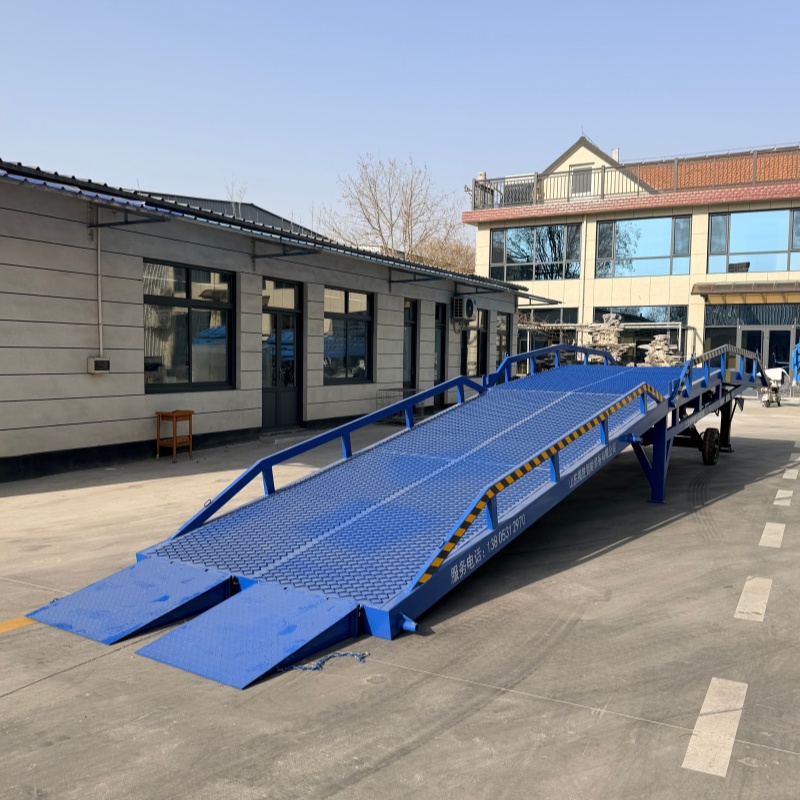
We supply custom mobile container loading ramps for global logistics buyers. Check ramp specs, OEM customization options, market demand shifts and factory direct manufacturing perks for distributors.
1. Logistics Industry Boom Pushes Up Orders for Mobile Loading Ramps
Cross-border trade, overseas factory setups and international shipping volumes keep climbing year after year. All these changes make fast, easy cargo loading more important than ever for every supply chain player.
Warehouses, manufacturing workshops, freight yards, ports and distribution hubs often don’t have space or budget to build fixed loading bays. This is where mobile container loading and unloading ramps fill the gap perfectly.
Business owners want to cut labor costs, speed up container turnarounds and keep staff safe on site. That’s why many plant managers choose to buy mobile loading equipment from dedicated OEM factories. Good ramp makers offer tailor-made designs, stable build quality and products that meet global safety standards, becoming trusted long-term partners for logistics operators.
2. Global Market Status & Future Industry Prospects
2.1 Cargo Handling Equipment Market Keeps Growing Steadily
Industry research shows consistent rising demand for loading machinery across APAC, Europe, the Middle East and Latin America. Key growth drivers include rebounding import and export trade, more automated warehouse builds, and heavy investment in logistics infrastructure worldwide.
Old-school manual loading takes too much time and carries higher accident risks. More companies switch to forklift-compatible mobile ramps to move more goods each shift with fewer safety hazards. For overseas importers, regional dealers and construction project contractors, sourcing from a trusted OEM ramp factory is the most cost-efficient way to get reliable loading gear.
2.2 Different Regions Have Unique Equipment Needs
Clients based in Southeast Asia, Africa, South America and Eastern Europe heavily favor mobile ramps. Most local storage facilities lack permanent dock infrastructure, so mobile models let teams start loading shipments right away without expensive construction work.
OEM factories adjust their production lines to match local working conditions: buyers can pick custom lengths, higher load limits, improved hydraulic lifting parts, and surface treatments that resist rust in humid or coastal climates.
3. Key Market Trends That Shape Buyers’ Decisions
3.1 Warehouse Automation Drives Equipment Upgrades
More warehouses now run electric pallet trucks, forklifts and automated sorting systems. Business owners shop for loading ramps that fit seamlessly with their existing workflow, rather than generic one-size-fits-all units.
3.2 Long Service Life & Eco-Friendly Builds Matter More
Today’s international buyers don’t only look at upfront prices. They judge equipment by how long it lasts, how often it needs maintenance, whether parts can be recycled, and what coatings are used on the steel frame. Ramps built with thick structural steel and anti-corrosion paint stand out against competitors in global trade.
3.3 Custom Orders Are No Longer Extra, They’re Standardseas distributors rarely only buy standard-sized ramps anymore. Most reach out to OEM/ODM factories to request bespoke features such as:
Custom platform lengths and widths
Adjustable hydraulic lifting heights
Non-slip textured deck surfaces
Printed brand logos and company markings
Hydraulic and electrical parts built to match regional standards
Special designs to work with specific forklift models
These small custom tweaks help local sellers win more orders in their home markets.
4. Core Technical Details for Mobile Container Loading Ramps
Factories adjust measurements based on each client’s request, but most standard mobile ramps share these common specs:
Load capacity options: 6T, 8T, 10T, 12T, 15T
Overall length: 10,000–12,000 mm
Width range: 2,000–2,200 mm
Adjustable lifting height: 900–1,800 mm
Platform slope: roughly 8% to 12%
Full hydraulic lifting system
Heavy-duty solid or air-filled tires
Thick high-strength steel main body
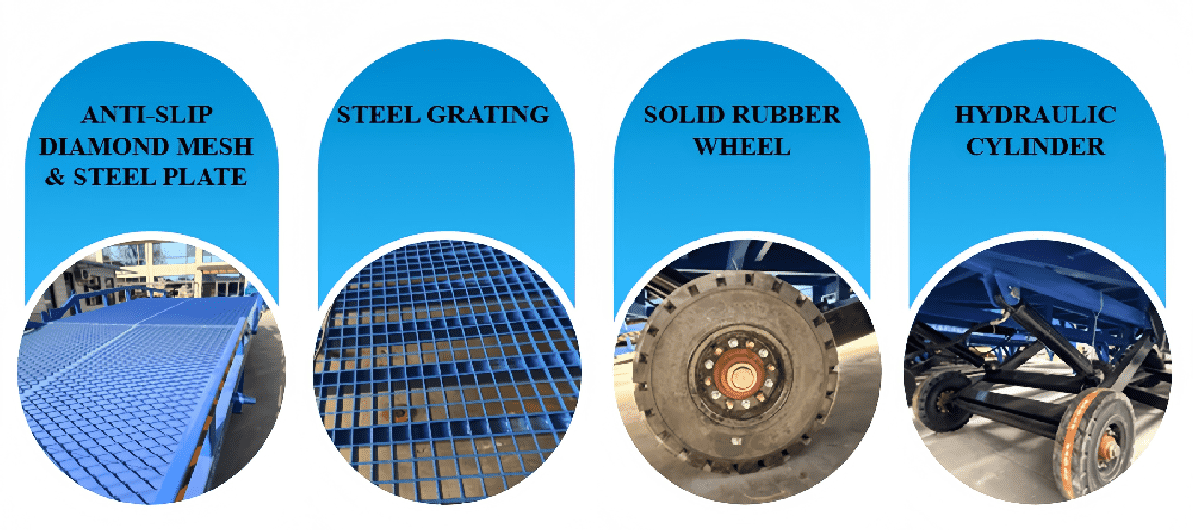
Checkered anti-slip steel deck
Side safety railings
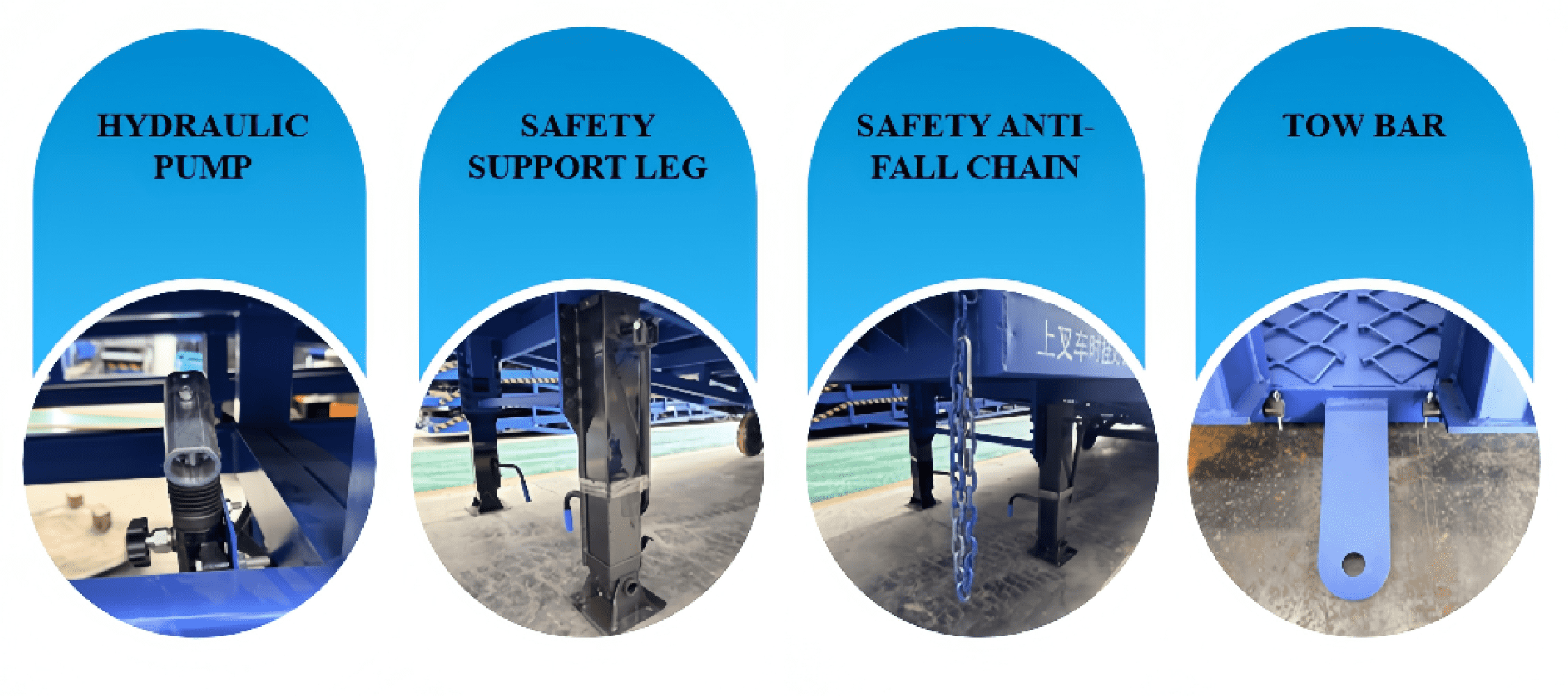
Securing safety chains to lock onto shipping containers
With this setup, forklift operators can safely drive straight from ground level into sealed shipping containers without extra support structures.
4.1 Main Structural Parts Breakdown
Professional OEM factories build every ramp with five core functional sections:
1. Heavy Steel Main Frame Made from thick structural steel plates, welded with precise processes to keep the frame rigid even under full load and extend working lifespan.
2. Loading Platform Covered with raised checkered steel to stop forklift wheels slipping, whether the floor is dry or damp from rain or warehouse spills.
3. Hydraulic Height Adjust Unit Powered by industrial hydraulic cylinders, letting operators smoothly raise or lower the ramp to align with different truck beds and container floors.
4. Full Safety Package Includes locking safety chains, side guard rails, wheel stoppers, supporting legs and anti-slip surfaces to cut workplace accident risks during daily loading work.
5. Mobility Wheels & Towing Kit Robust wheels and a simple towing hook let staff move the ramp between different loading zones quickly; no permanent installation required.
5. Standard OEM Production Flow for Consistent Product Quality
Reputable ramp manufacturers stick to a fixed production schedule to keep quality steady across bulk orders:
5.1 Raw Material Screening
We pick certified structural steel according to clients’ weight load requirements and international machinery manufacturing rules.
5.2 CNC Cutting & Shaping
Laser or plasma CNC cutting machines ensure precise dimensions and reduce small errors during forming.
5.3 Robotic Welding for Key Structures
All critical joints are welded with standardized procedures to guarantee overall structural strength, abrasion resistance and long-term stability under frequent heavy-duty use.
5.4 Professional Surface Treatment
Steel parts go through shot blasting first, then coated with epoxy primer and polyurethane topcoat or powder coating. This multi-layer treatment effectively resists rust, scratches and outdoor weather erosion for long service life.
5.5 Assembly & Functional Testing
Hydraulic systems, wheels, support legs and all safety accessories are fully assembled first. Every unit undergoes repeated lifting, moving and load simulation tests to ensure stable performance.
5.6 Strict Final Inspection
Before shipment, each ramp is fully checked on dimensional accuracy, welding quality, hydraulic sensitivity, static and dynamic load performance, surface finish and packaging condition to meet export standards.
6. Wide Industry Application Scenarios
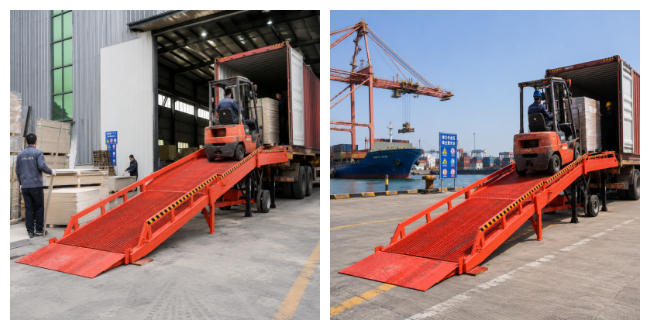
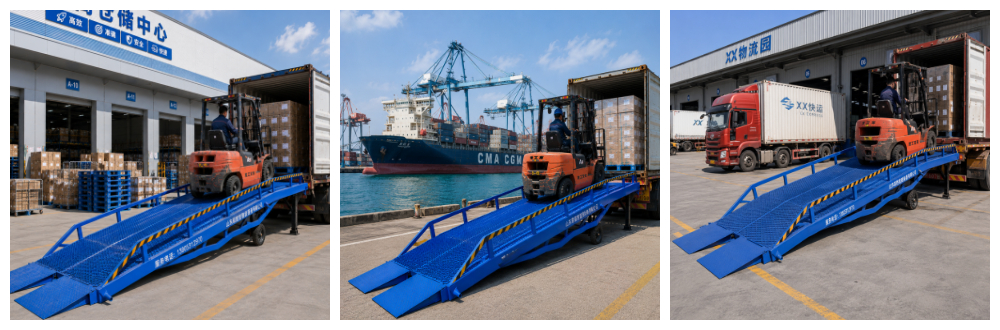
Thanks to its high flexibility and cost savings, mobile container loading ramps are widely used in various industrial scenarios:
Manufacturing plants and factory warehouses
Third-party logistics and distribution centers
Freight forwarding and shipping companies
Port and terminal logistics operations
Agricultural and food processing facilities
Construction material and hardware suppliers
Automotive component factories
Retail and e-commerce distribution hubs
Export packaging and warehousing facilities
For any site without fixed loading docks, mobile ramps offer the most practical and budget-friendly loading solution.
7. International Buyers’ Core Purchasing Preferences
Global importers no longer choose suppliers based only on low prices. They focus on comprehensive factory strength and long-term cooperation value.
Key purchasing factors include stable OEM production capacity, complete international certifications, flexible customization, on-time delivery, and full set of technical documents for import clearance and daily operation.
8. Common Procurement Pain Points for Overseas Buyers
Many overseas buyers face recurring problems when sourcing mobile ramps. Common issues include unstable product quality caused by low-grade steel and rough welding, insufficient load testing leading to safety hazards, and slow after-sales support.
In addition, oversized ramp products bring high freight costs. Professional OEM factories optimize structural design and export packaging to lower shipping fees while protecting equipment during long-distance transportation. Buyers also require transparent production records, factory audit materials and complete export documents before shipment.
9. Future Industry Development Trends
With continuous warehouse modernization and industrial automation upgrades in emerging markets, global demand for high-efficiency mobile loading equipment will keep rising.
Future product iteration will focus on smarter hydraulic control, lightweight high-strength materials, stronger anti-corrosion performance, modular assembly design, IoT-based maintenance monitoring and safer operating systems. Manufacturers with independent R&D, flexible customization and international compliance will occupy more market share.
10. Conclusion
Efficient and flexible container loading solutions have become essential support for modern global logistics. Mobile container ramps stand out for their low infrastructure cost, high mobility and wide adaptability.
When selecting suppliers, global buyers now prioritize manufacturing quality, customization capability, delivery stability and after-sales service rather than simply comparing prices. Partnering with a professional OEM ramp manufacturer helps distributors and end users reduce overall operation costs and improve logistics efficiency in the long run. It is recommended to verify technical drawings, test reports and product samples before bulk ordering.
11. Frequently Asked Questions
11.1 Q1. What load capacities are commonly available?
Standard mobile container ramps cover 6T to 15T load capacity. Custom heavy-duty models for larger industrial loads are also available.
11.2 Q2. Can the ramps be customized?
Yes. OEM and ODM customization is fully supported, including platform size, hydraulic lifting range, deck design, load capacity, brand printing and regional standard configuration to fit different forklifts and container types.
11.3 Q3. What documents do overseas buyers need for import?
Buyers can request technical drawings, material spec sheets, load test reports, quality inspection records, operation manuals, packaging lists and relevant certification documents to support import customs clearance.
11.4 Q4. How to get accurate pricing and technical support?
To obtain precise quotes and professional solutions, buyers are suggested to provide detailed requirements including required load capacity, ramp dimensions, application scenarios, destination country and annual purchase volume.