Loading Ramp: Ultimate Guide for Global Wholesale Loading Ramp & Unloading Ramp Supplier
Loading Ramp | Wholesale Unloading Ramp & Reliable Supplier
Trusted loading ramp supplier offers durable mobile & stationary unloading ramp. Explore 2026 market trends, specs & B2B wholesale solutions.
1. Global Loading Ramp Industry Background & Market Overview
1.1 Industry Development Background
The global logistics and industrial material handling sector has undergone rapid modernization over the past five years, pushing loading ramp and unloading ramp equipment from auxiliary accessories into core infrastructure for warehouse operations, freight transit, and factory cargo turnover. As cross-border trade recovers and global e-commerce warehousing expands, traditional fixed docking facilities can no longer adapt to flexible, high-frequency loading and unloading demands. A professional loading ramp supplier plays a decisive role in solving cargo transfer pain points for global enterprises, providing cost-effective, high-safety, and multi-scenario adaptable ramp solutions for logistics companies, manufacturing plants, and freight terminals worldwide.
Unlike fixed dock equipment, flexible loading ramp and unloading ramp products feature unrestricted site usage, fast deployment, and low installation costs, effectively solving the operational bottlenecks of temporary warehouses, mobile freight yards, and non-standard docking heights. This core advantage drives continuous market penetration growth and makes standardized, export-grade ramp products a hot-selling category in global B2B industrial equipment procurement.
1.2 2026 Global Market Size & Statistical Data
Authoritative industry data shows that the global loading ramp market reached USD 2.2 billion in 2025, with a steady compound annual growth rate of 5.2% projected from 2026 to 2034, expected to exceed USD 3.5 billion by 2034. The logistics and warehousing industry dominates terminal demand, accounting for 38.5% of the overall market share, while manufacturing and cross-border freight industries follow with sustained stable demand growth.
From product segmentation, mobile loading ramp products maintain the fastest growth rate with a 6.1% CAGR, thanks to their strong adaptability to scattered operation sites and temporary docking scenarios. Regionally, the Asia-Pacific region holds a 35.2% global revenue share as the core production and export base, while North America and Europe remain high-value consumer markets with strict requirements for product safety, material durability, and certification compliance. In 2026, global B2B procurement demand for customized, high-load, and corrosion-resistant loading ramp and unloading ramp products increased significantly, bringing new development opportunities for professional loading ramp supplier enterprises.
1.3 Global Regional Demand Characteristics
European and American markets prioritize safety certification and standardized configurations, requiring all exported loading ramp and unloading ramp products to comply with CE, ISO9001 and local workplace safety regulations, with high thresholds for load accuracy and anti-slip performance. The Southeast Asian, Middle Eastern, and Latin American markets focus more on cost performance, corrosion resistance, and adaptability to high-temperature and humid environments, favoring durable and low-maintenance ramp products. As a comprehensive loading ramp supplier, matching differentiated regional procurement needs has become the core competitiveness of overseas market expansion.
2. Core Product Technical Specifications & Standard Configurations
2.1 Main Product Classification & Applicable Scenarios
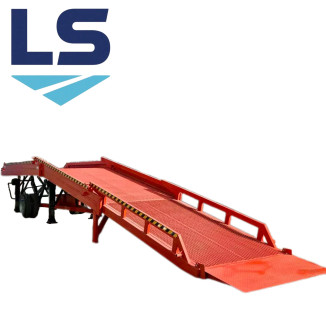
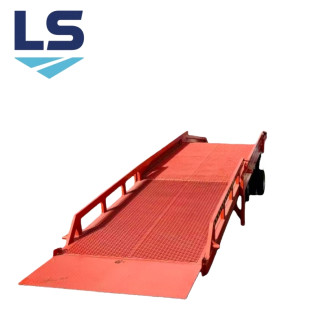
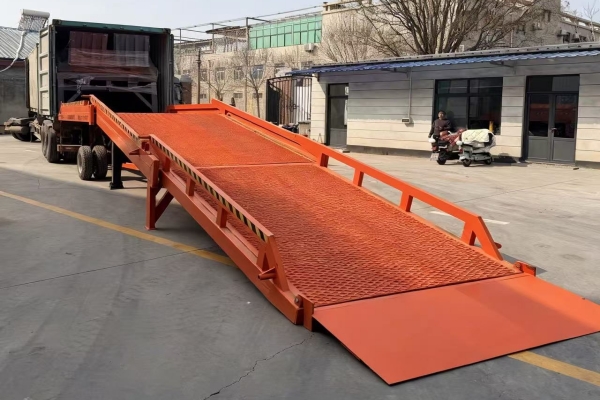
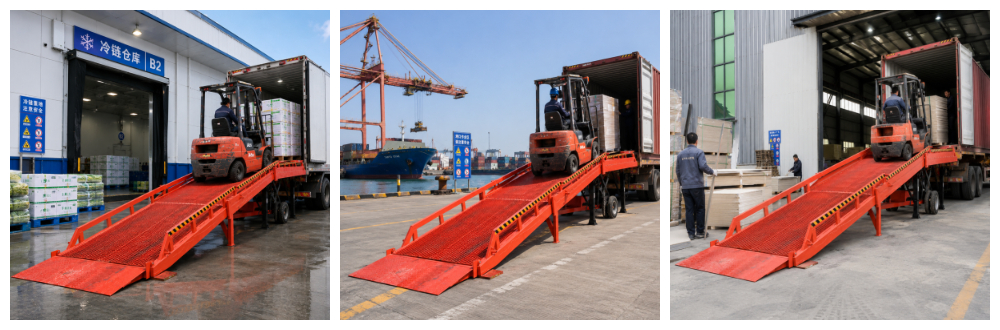
Mainstream export-grade loading ramp and unloading ramp products are divided into two core categories: mobile yard loading ramps and stationary dock loading ramps, covering all mainstream global application scenarios. Mobile loading ramps are suitable for temporary freight yards, unattended docks, and multi-site switching operations, supporting free movement and rapid deployment without fixed installation. Stationary unloading ramps are fixed at warehouse docks, realizing long-term stable height adjustment and efficient cargo turnover, ideal for large-scale fixed logistics distribution centers.
Common product load specifications cover 6-ton, 8-ton, 10-ton, and 12-ton heavy-duty models, fully matching the operation needs of manual forklifts, electric forklifts, and full-load cargo transfer. As a professional loading ramp supplier, we support customized width, length, and load parameters to meet special scenario requirements such as super-large cargo and narrow-channel operation.
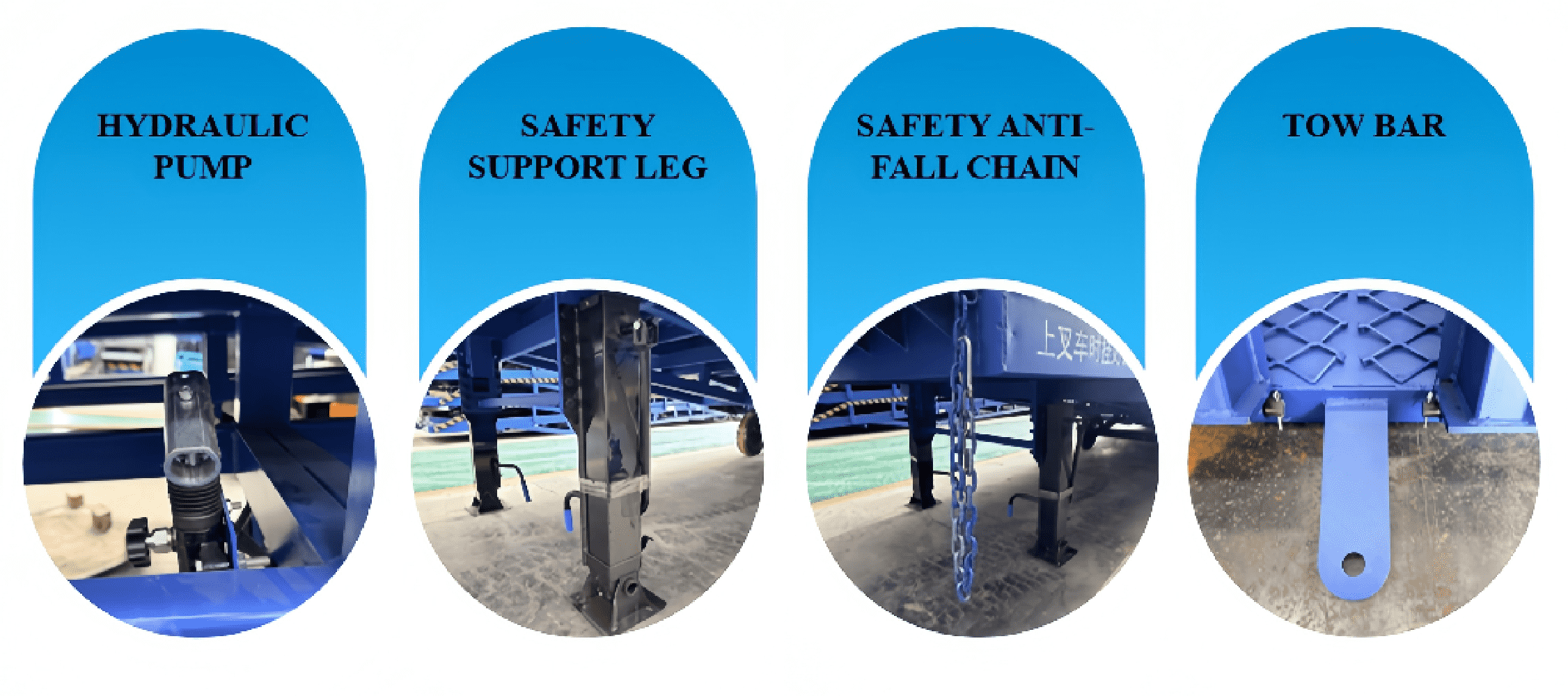
2.2 Core Material & Safety Configuration Standards
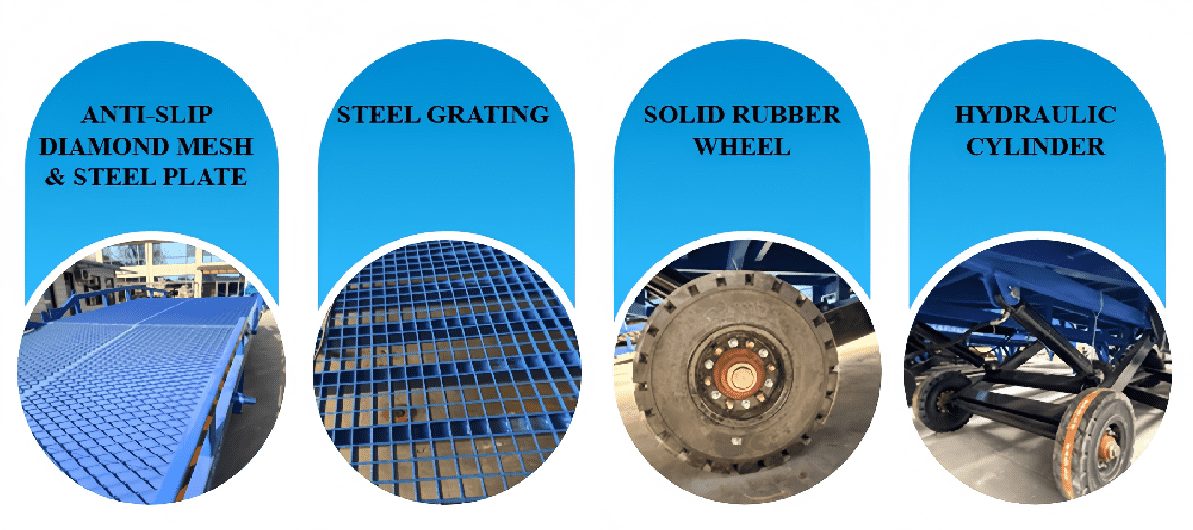
High-quality loading ramp and unloading ramp products adopt high-strength manganese steel and aviation-grade aluminum alloy materials. Manganese steel ramps feature strong compression resistance and impact resistance, suitable for long-term heavy-load industrial scenarios; aluminum alloy ramps are lightweight, corrosion-resistant, and rust-proof, adapting to humid coastal and high-temperature outdoor environments, with a market growth rate of 6.78% in recent years.
Standard export configurations include anti-slip grid patterns, hydraulic height adjustment systems, safety guardrails, anti-collision rubber buffers, and emergency braking devices. All adjustable loading ramp products support 0–300mm height difference adaptation, solving the docking height difference problem between trucks, containers, and warehouse floors. The full set of safety configurations effectively avoids cargo sliding and equipment tilting risks, fully complying with international workplace safety operation standards.
2.3 Standard Manufacturing & Processing Procedures
Formal loading ramp supplier enterprises implement standardized whole-process manufacturing to ensure product stability and durability. The complete production process includes raw material screening and cutting, robotic integral welding, hydraulic system assembly, surface anti-rust spraying, safety performance testing, and finished product calibration. All welding parts adopt full penetration welding technology to avoid structural deformation and fracture under long-term load.
Before delivery, each batch of loading ramp and unloading ramp products undergoes strict static load testing, anti-slip detection, and hydraulic lifting aging tests to ensure no oil leakage, stable height locking, and uniform force bearing. The surface adopts multi-layer anti-rust paint treatment, which can resist outdoor wind and rain erosion and extend the service life to more than 8 years, meeting the long-term use needs of global B2B buyers.
3. 2026 Industry Development Trends & Procurement Evolution
3.1 Intelligent & Customized Upgrading Trend
With the upgrading of global intelligent warehousing, customized and intelligent loading ramp products have become the mainstream procurement trend. More and more overseas buyers prefer electric hydraulic automatic adjustment ramps and AGV-adaptive precision docking unloading ramp products, which can be seamlessly connected with intelligent warehouse equipment to improve overall logistics efficiency. Professional loading ramp supplier continue to optimize product structures, launch lightweight narrow-body ramps and heavy-duty reinforced ramps to meet differentiated scenario needs.
3.2 Green Environmental Protection & Safety Compliance Trend
Global environmental protection and safety supervision standards are increasingly strict, promoting the loading ramp industry to achieve green upgrading. New-generation loading ramp and unloading ramp products adopt low-carbon spraying materials and energy-saving hydraulic systems, realizing zero pollution and low energy consumption. Meanwhile, unified safety certification has become a necessary threshold for product export, and certified compliant products have completely replaced non-standard low-quality products in mainstream overseas markets.
3.3 Buyer Procurement Preference & Core Pain Points
Through analysis of global B2B procurement data, international buyers’ core purchasing preferences focus on three points: stable load-bearing accuracy, strong environmental adaptability, and complete certification documents. The main procurement pain points of overseas buyers include unstable load capacity of low-quality ramps, easy rust and damage, incomplete export certifications leading to customs clearance obstacles, and lack of professional after-sales technical support.
Choosing a formal and reliable loading ramp supplier can effectively solve the above pain points. Standardized factory production, complete CE/ISO certification systems, and professional overseas after-sales services have become the key factors for buyers to screen high-quality suppliers.
4. B2B Buyer FAQ for Loading Ramp & Unloading Ramp
Q1: What is the difference between mobile loading ramp and stationary unloading ramp?
Mobile loading ramps are freely movable and require no fixed installation, suitable for temporary docks, multiple site switching and flexible freight operation scenarios, with low investment cost and high flexibility. Stationary unloading ramps are fixed at warehouse docks, featuring higher stability and larger load capacity, suitable for long-term, high-frequency, and large-volume cargo turnover. Buyers can select models according to their fixed or mobile operation demands.
Q2: What certifications are required for export loading ramp products?
Formal export loading ramp and unloading ramp products need ISO9001 quality system certification and CE safety certification to meet European and American market access standards. Products exported to the Middle East and Southeast Asia need to meet local anti-corrosion and high-temperature resistance standards. A qualified loading ramp supplier will provide complete certification documents and customs clearance materials to ensure barrier-free export.
Q3: How to choose the right load specification for loading ramp?
It is recommended to select the load capacity according to the total weight of forklift plus full-load cargo. For conventional light and medium cargo turnover, 6–8 ton ramps are sufficient; for heavy machinery and large cargo transportation, 10–12 ton heavy-duty reinforced loading ramp is recommended. Professional suppliers can provide one-on-one model selection technical guidance according to actual working conditions.
Q4: What is the service life and daily maintenance method of the ramp?
High-standard manganese steel and aluminum alloy loading ramp products have a service life of 8–12 years under normal use. Daily maintenance is simple: regularly check hydraulic oil volume, clean surface dust and sundries, inspect welding joints and anti-collision parts, and avoid long-term overload use. Our products support long-term after-sales maintenance guidance and spare parts supply.
5. Professional B2B Procurement Call to Action
As a reliable and professional global loading ramp supplier, we focus on the R&D, production and export of high-quality loading ramp and unloading ramp products, covering mobile, stationary, customized heavy-duty and anti-corrosion series products. All products comply with international safety standards, complete with full export certifications, and support OEM/ODM personalized customization to meet the differentiated procurement needs of global logistics enterprises, manufacturing factories, and freight companies.
We provide one-stop B2B services including professional model selection consultation, free technical parameter documents, customized product samples, bulk preferential quotations, and global after-sales guarantee. Whether you need small-batch retail procurement or large-scale wholesale orders, we can deliver high-cost-performance standard products and tailored solutions.
Contact our professional foreign trade team right now to obtain the latest 2026 product catalog, real-time wholesale quotation, and exclusive industry loading and unloading solution suggestions to help your business occupy more market share in the global material handling equipment industry.