Dock Loading Ramp: Industrial-Grade Loading Ramp for Global Warehouse & Port Logistics
Dock Loading Ramp | Heavy-Duty Industrial Loading Ramp for Logistics
Premium dock loading ramp & loading ramp solutions. Explore 2026 market trends, technical specs, procurement tips for global dock logistics operations.
1. Global Industry Background & 2026 Market Statistics
1.1 Industry Development Overview
Global cross-border trade expansion, intelligent warehouse upgrading and port infrastructure renovation have continuously driven stable demand for industrial cargo-handling equipment. The dock loading ramp, as a core auxiliary facility
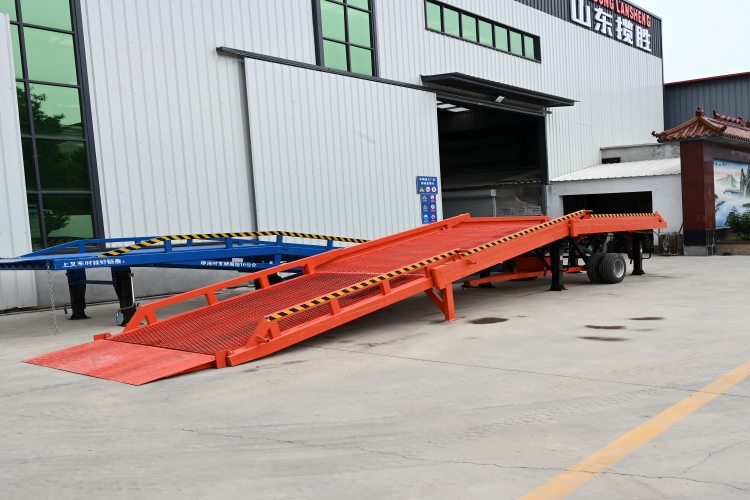
for dock and warehouse operations, effectively solves the height difference between fixed docks, container trucks and warehouse platforms. A high-quality dock loading ramp enables forklifts to complete continuous loading and unloading operations safely and efficiently, greatly improving the turnover efficiency of modern logistics yards. Compared with traditional fixed dock levellers, a flexible loading ramp features lower installation costs, stronger scene adaptability and no need for large-scale civil engineering transformation, making it increasingly popular among global medium and small logistics enterprises, terminal operators and manufacturing factories.
In recent years, the growth of third-party logistics, bonded warehousing and temporary freight terminals has further accelerated the replacement cycle of traditional handling equipment. Standardized, high-safety and high-durability dock loading ramp products have become rigid procurement demands in the global industrial equipment market, forming a stable and incremental market development pattern.
1.2 Authoritative Global Market Data & Growth Forecast
According to 2026 global logistics equipment industry research data, the global dock loading ramp market reached USD 2.2 billion in 2025, with a steady compound annual growth rate of 5.2% from 2026 to 2034, and is expected to exceed USD 3.5 billion by 2034. The stable growth is mainly attributed to the continuous investment in global warehouse renovation and port infrastructure construction, as well as the accelerated renewal of aging logistics handling equipment.
From market segmentation, stationary dock loading ramp occupies the largest market share in fixed port and large warehouse scenarios, while mobile loading ramp maintains a faster growth rate in flexible operation scenarios such as temporary freight yards and mobile container terminals. Regionally, Europe and North America dominate the high-standard market with strict safety certification requirements, while the Asia-Pacific region serves as the core production and export base, and emerging markets in Southeast Asia, Latin America and the Middle East continue to release huge incremental procurement demand.
2. 2026 Industry Development Trends & Procurement Changes
2.1 Safety Compliance & Standardization Upgrading
Global workplace safety supervision standards are becoming increasingly standardized and stringent. In European, American and Oceanian markets, imported dock loading ramp and loading ramp products must pass CE mechanical safety certification and ISO quality system certification to meet local legal operation requirements. Non-standard products with unqualified load parameters and insufficient safety configurations are gradually eliminated from mainstream B2B procurement markets. Safety compliance has become the primary threshold for global suppliers to enter high-end markets.
2.2 Scenario Customization & Durability Optimization
With the diversification of global logistics operation scenarios, standardized general-purpose loading ramp can no longer fully meet differentiated working conditions. Customized demand for dock loading ramp is rising rapidly, including enhanced anti-corrosion models for coastal high-salt-fog environments, reinforced heavy-duty models for industrial heavy cargo handling, and narrow-size customized models for compact warehouse docks. Meanwhile, buyers pay more attention to product durability and full-cycle use cost, rather than simply pursuing low unit prices.
2.3 Mobile Hydraulic Products Become Mainstream
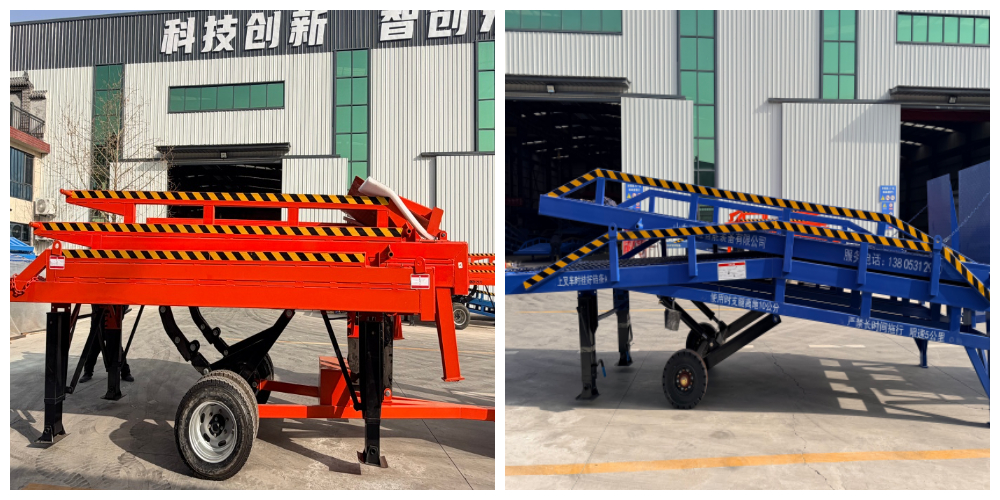
Affected by the asset-light operation trend of global logistics enterprises, mobile hydraulic dock loading ramp has become the fastest-growing segmented product. It supports free movement and flexible height adjustment, adapting to frequent site switching and temporary docking operations. It effectively reduces the fixed asset investment pressure of logistics enterprises and has become the preferred solution for most small and medium-sized logistics buyers.
Natural integrated long-tail keywords: CE certified dock loading ramp for warehouse docks, hydraulic adjustable mobile loading ramp for freight yards, heavy-duty dock loading ramp for port cargo handling, anti-corrosion loading ramp for coastal logistics terminals.
3. Product Technical Specifications, Structure & Manufacturing Process
3.1 Core Product Structure & Technical Parameters
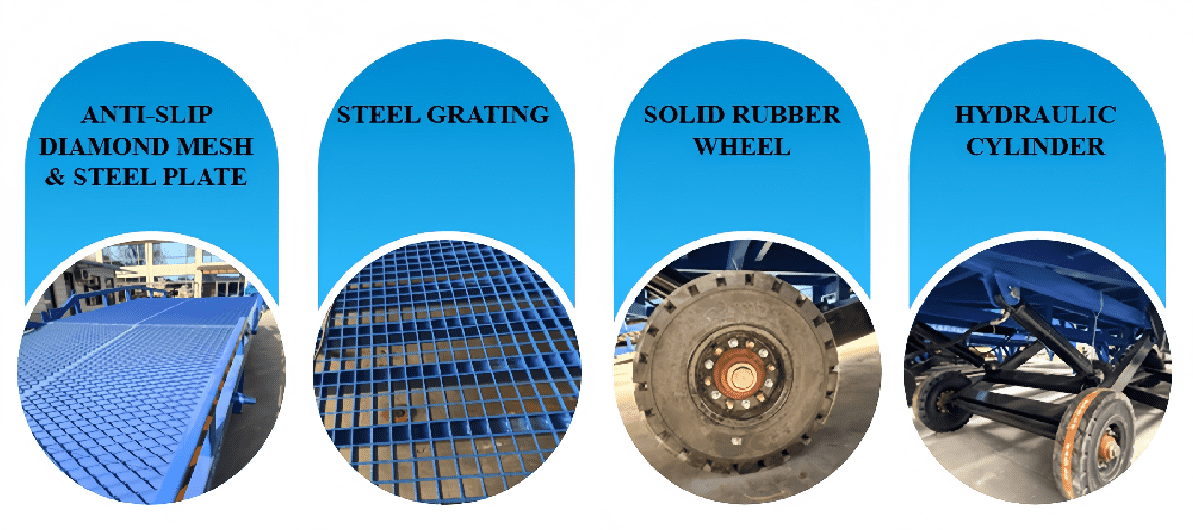
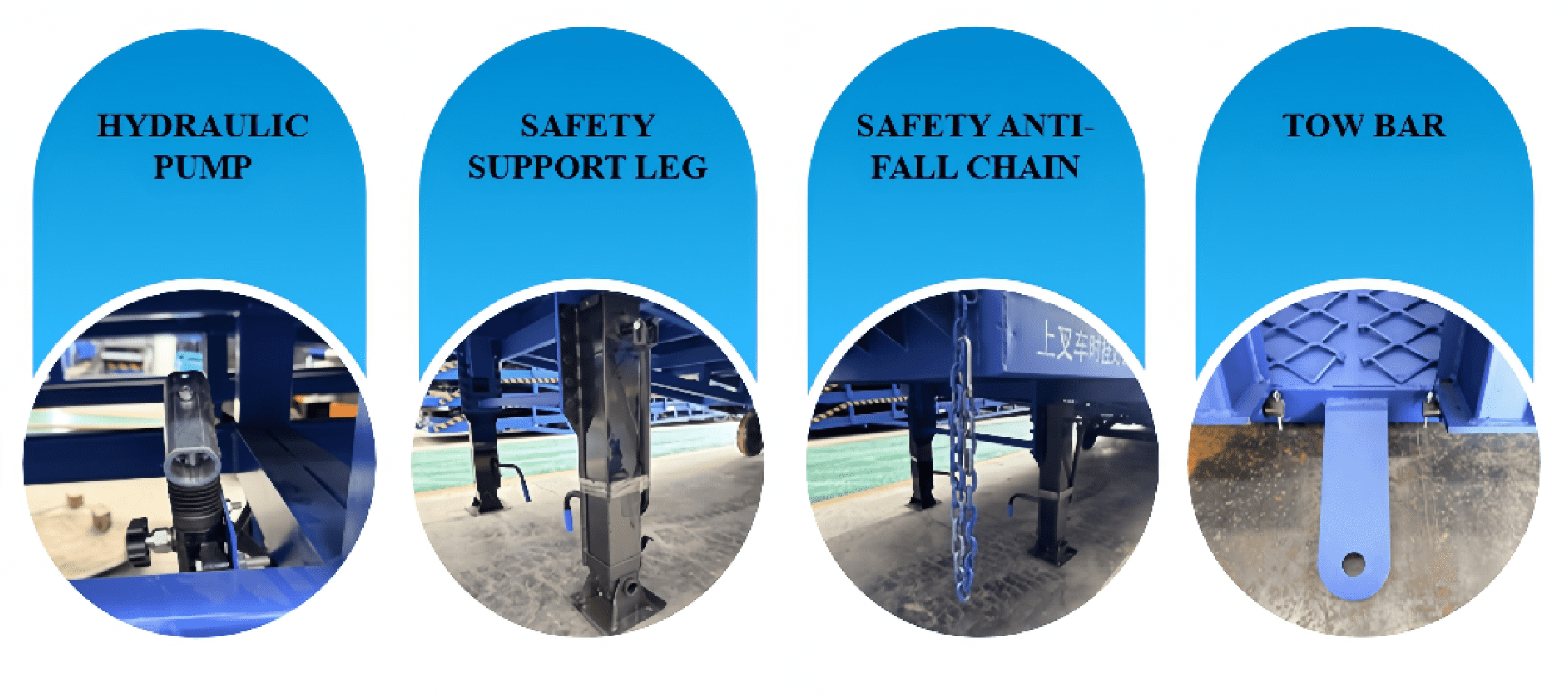
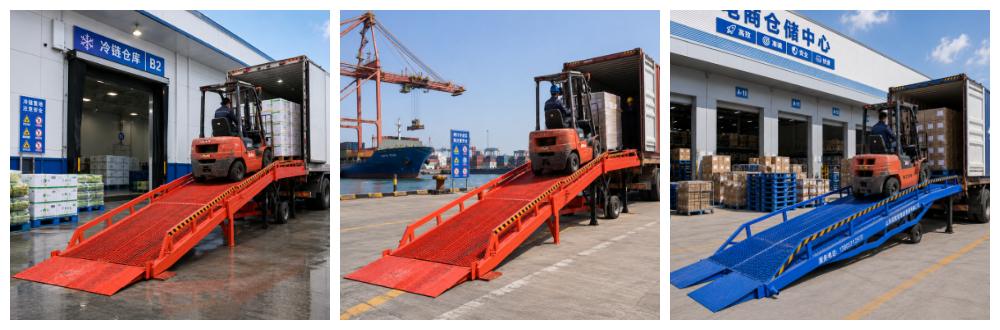
Standard export-grade dock loading ramp and loading ramp adopt high-strength manganese steel and low-alloy steel integrated welding structure, with strong compression resistance, impact resistance and structural stability. The core structure includes load-bearing main beam, anti-slip grating platform, hydraulic lifting system, safety anti-displacement device and stable support legs. The serrated anti-slip platform ensures effective drainage and anti-skid performance in rainy and humid environments, avoiding forklift slipping risks.
Conventional mainstream specifications cover 6-ton to 15-ton safe working load, with an adjustable height range of 900mm to 1700mm, fully matching the height difference of standard containers and truck docks. The product realizes stepless hydraulic height adjustment, with stable lifting and self-locking functions, which can adapt to different docking heights and ensure continuous and stable cargo handling operations.
3.2 Standard Manufacturing Process
High-quality dock loading ramp strictly implements standardized industrial production procedures. First, CNC precision cutting and forming of raw steel materials to ensure dimensional accuracy of all structural components. Second, robotic full penetration welding is adopted for main beam and platform supports to eliminate welding defects and enhance overall structural stability. Third, shot blasting rust removal and multi-layer anti-rust electrostatic spraying are carried out to improve outdoor anti-corrosion and anti-aging capabilities.
After hydraulic component assembly and pipeline pressure testing, each finished loading ramp will undergo full-load static and dynamic load testing to verify bearing stability and hydraulic system tightness. Finally, complete technical documents and certification reports are sorted out before packaging and export shipment, ensuring that each batch of products meets international B2B quality standards.
3.3 Practical On-Site Application Workflow
The operation of dock loading ramp is efficient and simple. Operators move the loading ramp to the docking position of truck or container, lower the support legs to fix the equipment, adjust the platform height through the hydraulic system to fit the dock and container floor height, and lock the safety self-locking device. After confirming stable connection, forklifts can safely drive in and out to complete batch loading and unloading operations. After the operation is completed, reset the hydraulic height and retract the support legs for subsequent transfer and storage, which greatly improves the flexibility of logistics site operation.
4. International B2B Buyers’ Procurement Preferences & Core Pain Points
4.1 Global Procurement Preferences
International professional buyers prioritize three core factors when purchasing dock loading ramp and loading ramp products: reliable dynamic load performance, complete export certification documents and long-term durability. Buyers will comprehensively evaluate supplier production capacity, factory test reports and after-sales service guarantee capabilities, and tend to choose manufacturers with standardized production systems and stable batch quality.
4.2 Common Procurement Pain Points
Most cross-border buyers face typical procurement problems: some low-cost loading ramp products exaggerate static load parameters but have insufficient dynamic load capacity, leading to structural deformation and safety hazards during forklift operation. Some products lack anti-corrosion treatment and are prone to rust and damage in outdoor and coastal environments. In addition, many small suppliers cannot provide complete certification documents, resulting in customs clearance delays and inability to use locally. Inadequate after-sales spare parts supply and technical guidance also increase the long-term operation cost of buyers.
5. Frequently Asked Questions for Global B2B Buyers
Q1: What is the difference between static load and dynamic load of a dock loading ramp?
Static load refers to the maximum static bearing capacity of the loading ramp, while dynamic load refers to the safe bearing capacity when a forklift travels with full cargo. Daily dock loading and unloading operations belong to dynamic load scenarios. Buyers must select models according to dynamic load parameters and reserve 20% safety redundancy to avoid structural damage and safety risks.
Q2: Is customized service available for special dock working conditions?
Yes. Professional manufacturers support personalized customization of dock loading ramp, including special width, length, load capacity, and enhanced anti-rust and anti-corrosion treatment for harsh environments. Buyers can provide actual dock height difference, site space and environmental conditions to obtain exclusive customized loading ramp solutions.
Q3: What certifications are required for exporting dock loading ramp to Europe and America?
Formal export products need CE machinery safety certification and ISO9001 quality system certification, together with factory load test reports and product operation manuals. Complete certification documents ensure smooth customs clearance and compliance with local workplace safety regulations, avoiding usage restrictions and legal risks.
Q4: What are the core advantages of hydraulic dock loading ramp?
Hydraulic dock loading ramp features stepless height adjustment, stable operation and strong terrain adaptability. It requires no fixed installation, supports flexible docking of various container and truck heights, and effectively reduces manual handling costs and site transformation investment, which is suitable for most global dock and warehouse logistics scenarios.
6. Professional B2B Call to Action
We are a professional manufacturer and exporter specializing in the R&D, production and customization of high-quality dock loading ramp and industrial loading ramp. Adhering to strict international production standards, our products feature stable load performance, excellent anti-slip safety and strong environmental adaptability, fully meeting the differentiated procurement needs of global warehouses, port terminals, freight yards and manufacturing enterprises.
We provide one-stop B2B supporting services including free technical parameter documents, product sample support, personalized solution design, bulk preferential quotations and global after-sales guarantee. Whether you need standard loading ramp wholesale or customized dock loading ramp for special working conditions, our professional foreign trade and technical team can provide accurate and reliable procurement solutions.
Contact us today to get the latest 2026 product catalog, real-time wholesale quotation and professional cargo handling optimization suggestions to help you improve operational efficiency and reduce logistics equipment investment costs.