Container Loading Ramp: Global Market Trends, Specs & B2B Buying Guide
Container Loading Ramp | Warehouse Loading Dock Platform Ultimate Guide 2026
Explore 2026 container loading ramp market trends, technical specs, application scenarios, and B2B buyer pain points for warehouse loading dock platform solutions.
1. Global Industry Backdrop & Market Statistical Analysis
The global logistics and warehousing industry has witnessed sustained expansion amid the rapid recovery of cross-border trade and the booming development of e-commerce supply chains. As a core auxiliary handling device for cargo entry and exit, the container loading ramp loading dock platform warehouse loading ramp has become indispensable infrastructure for ports, third-party logistics warehouses, manufacturing factories, and cross-border freight enterprises worldwide. According to the latest 2026 industry research data, the global mobile loading ramp market maintains a year-on-year growth rate of 6.8%, with the market size exceeding USD 1.2 billion. Driven by the upgrading of warehouse automation and the shortage of fixed loading docks, the demand for flexible, movable, and high-load-bearing loading ramp solutions continues to surge.
Regional market demand shows obvious hierarchical characteristics. North America and Europe occupy the largest consumption share, accounting for 58% of the global total market volume, as local enterprises have high requirements for logistics efficiency, workplace safety, and equipment standardization. The Asia-Pacific region has become the fastest-growing market with a compound annual growth rate of 8.2%, benefiting from the rapid expansion of manufacturing export bases and the continuous construction of small and medium-sized private warehouses. Unlike fixed dock levelers, the warehouse loading ramp features flexible deployment and low investment costs, perfectly matching the operational needs of small and medium-sized logistics enterprises, which is the core driver of its market penetration.
In the post-pandemic trade era, global enterprises are gradually abandoning traditional manual cargo handling modes and shifting to mechanized and semi-automatic loading and unloading solutions. This industry transformation has further stimulated the demand for high-performance container loading ramp loading dock platform products, eliminating the efficiency bottleneck caused by mismatched heights between container carriages and warehouse ground platforms.
2. 2026 Global Market Development Trend Analysis
2.1 High Load-Bearing & Customized Product Upgrading Trend
International buyers are no longer satisfied with single-standard loading ramp products. Heavy-duty models with a load capacity of 8–30 tons have become mainstream sales specifications, and customized products up to 50 tons are widely used in heavy machinery and bulk cargo handling scenarios. Traditional low-load and thin-plate loading ramps are gradually phased out of the high-end market due to poor stability and short service life. Modern container loading ramp products adopt Q355 and Q460 high-strength steel overall welding structures, which effectively improve structural rigidity and anti-deformation ability, adapting to long-term high-frequency forklift operation.
2.2 Safety & Environmental Compliance Standardization Trend
Global workplace safety regulations are becoming increasingly stringent. European CE certification and North American OSHA safety standards have become the basic threshold for product export. New-generation loading dock platform products are equipped with anti-slip serrated steel plates, anti-collision guardrails, and anti-skid support legs, with a surface friction coefficient higher than 0.9, which effectively prevents cargo and forklift slipping risks. In addition, the shot blasting and anti-rust paint treatment process replaces traditional simple spraying, meeting international environmental protection coating standards and extending the outdoor service life of equipment to more than 8 years.
2.3 Intelligent & Hydraulic Automatic Integration Trend
Manual height-adjusted loading ramps are gradually replaced by fully hydraulic automatic models. The integrated hydraulic lifting system realizes stepless height adjustment, which can freely adapt to container heights of 1.2–1.8 meters. The intelligent hydraulic control system features stable operation, low noise, and no oil leakage, solving the pain points of cumbersome adjustment and poor stability of traditional mechanical ramps. This warehouse loading ramp with hydraulic intelligent adjustment has become the preferred solution for large-scale standardized warehouses and cross-border freight terminals.
3. Core Technical Specifications & Product Composition
3.1 Key Standard Technical Parameters
High-quality container loading ramp loading dock platform warehouse loading ramp follows unified international manufacturing standards, with core parameters covering load capacity, overall dimensions, adjustment range, and structural configuration. The mainstream standard models have a load capacity of 10–20 tons, overall dimensions of 11600*2200*1100mm, and a valid working width of 1.8–2.2 meters, which is compatible with all mainstream electric and manual forklifts on the market. The hydraulic system adopts 24V low-voltage drive with a power of 0.75kW, realizing stable lifting and lowering without impact, suitable for continuous high-intensity operation.
The ramp slope is strictly controlled within the international standard range of 10%–15%, ensuring safe passage of forklifts carrying palletized goods and avoiding cargo tilting and slipping. The extended platform design (3000mm ultra-long platform for customized models) enables forklifts to directly reach the deep position of shipping containers, eliminating secondary cargo handling and greatly improving loading and unloading efficiency.
3.2 Complete Product Structural Composition
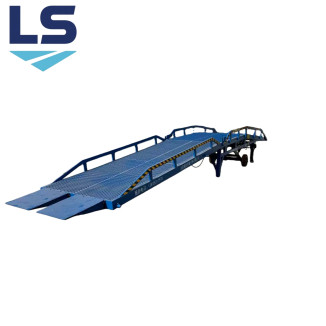
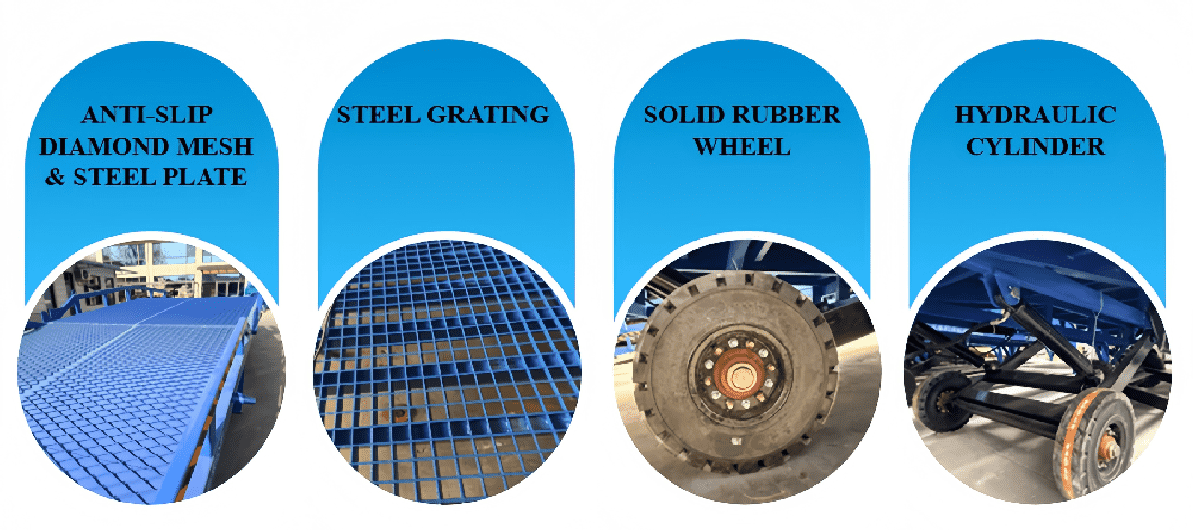
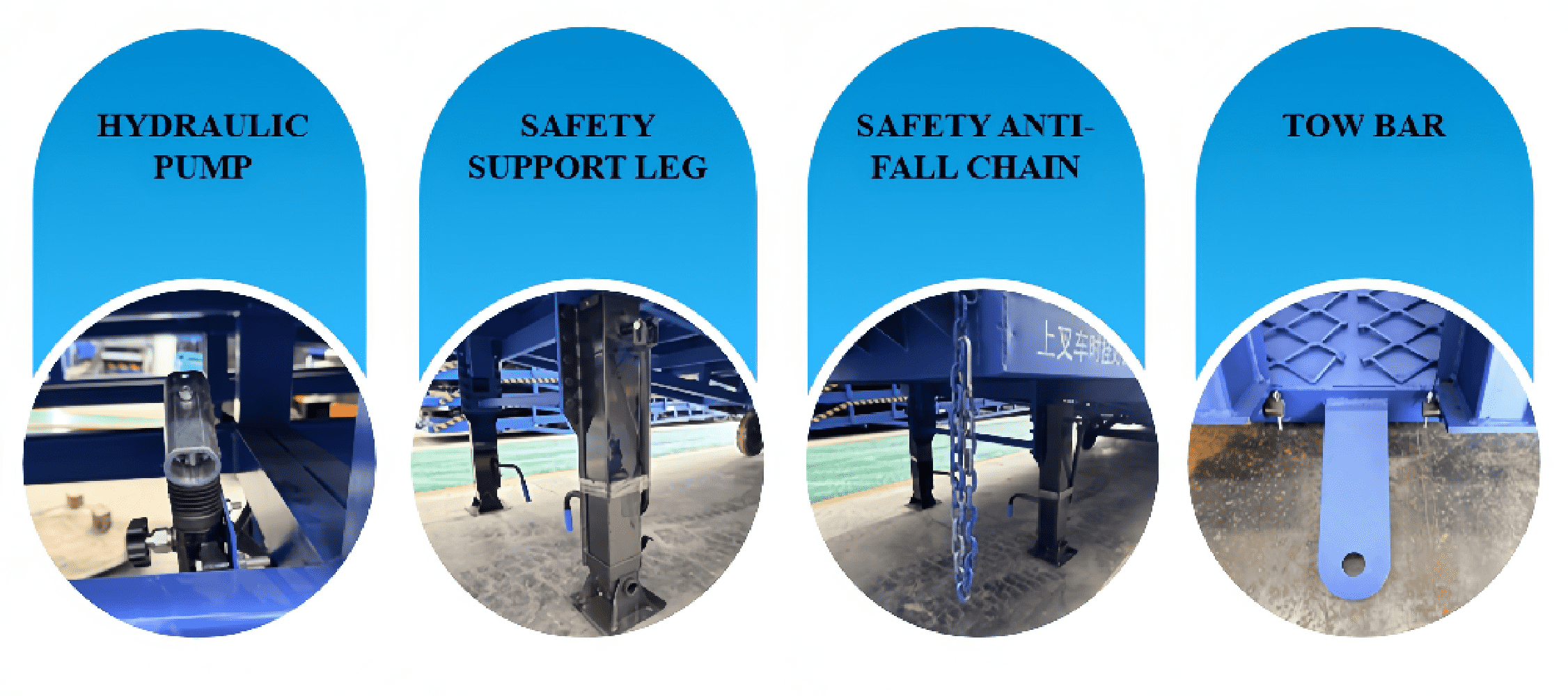
The whole set of container loading ramp equipment consists of five core components to ensure overall stability and durability. First, the main frame structure, made of integral high-strength channel steel and thickened steel plate welding, bears the main load pressure. Second, the anti-slip walking platform, adopting serrated steel plate stamping molding, with high friction and anti-wear performance. Third, the hydraulic lifting system, including imported hydraulic cylinders, oil pumps, and control valves, with stable performance and low failure rate. Fourth, the mobile walking mechanism, equipped with heavy-duty solid rubber wheels, realizing free movement of the whole equipment. Fifth, the safety protection system, including anti-collision blocks, limit protection devices, and fixed support legs, to ensure zero safety hazards during operation.
4. Standard Manufacturing & On-Site Application Procedures
4.1 Professional Manufacturing Process Flow
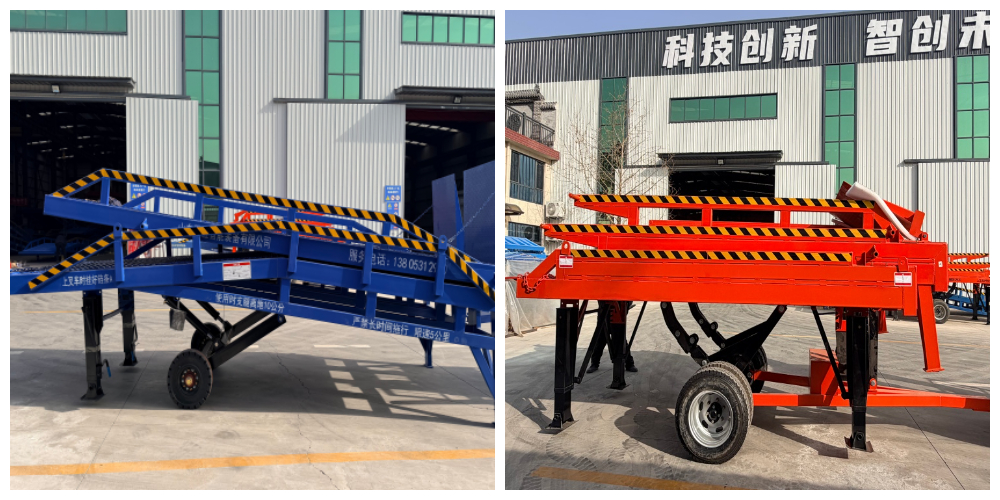
The production of high-standard loading dock platform follows rigorous industrial manufacturing procedures. First, raw material inspection, strictly screening high-strength steel plates and hydraulic accessories that meet international standards to eliminate unqualified raw materials. Second, precision cutting and bending, using CNC fully automatic equipment to ensure accurate component size and tight assembly gap. Third, integral welding, adopting full penetration welding technology to avoid virtual welding and missing welding, and conducting stress relief treatment to prevent structural deformation. Fourth, surface treatment, including shot blasting rust removal and multi-layer anti-rust paint spraying, to enhance corrosion resistance. Finally, factory debugging and load testing, conducting 1.25 times overload static pressure test and continuous lifting test to ensure product performance meets export standards before delivery.
4.2 Typical Warehouse & Container Application Scenarios
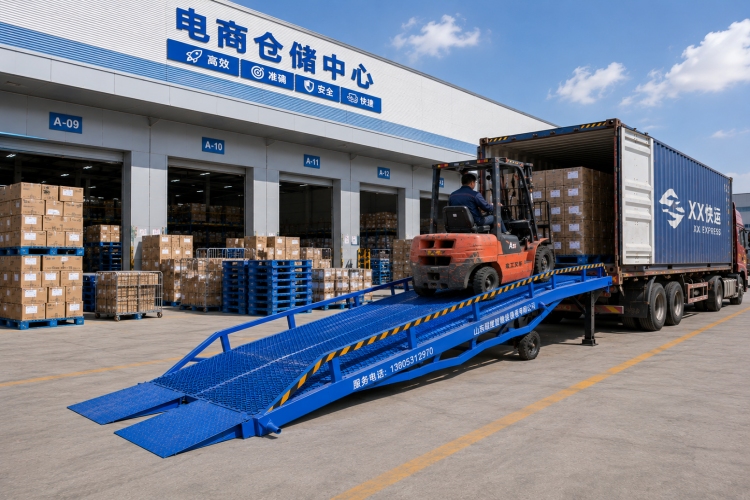
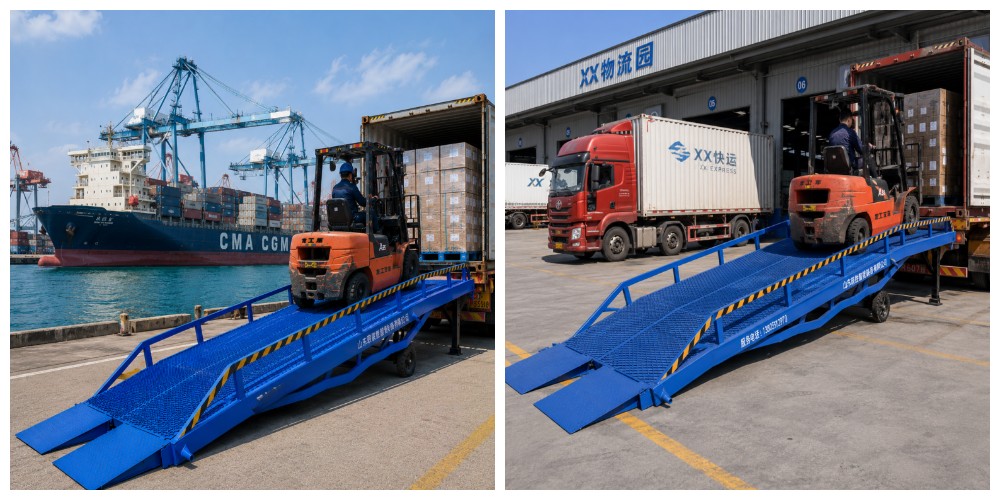
The warehouse loading ramp is widely applicable to diversified logistics scenarios without fixed loading docks. For container import and export operations, it can quickly connect ground and container carriage heights, realizing fast loading and unloading of container goods by forklifts. For daily warehouse incoming and outgoing goods, it matches various trucks and vans of different heights, solving the problem of height differences in vehicle docking. For temporary logistics distribution centers and outdoor freight yards, its movable design enables flexible switching of operation positions, avoiding the high cost and fixed limitations of building fixed loading docks. In addition, it is also suitable for factory production line cargo transfer, large equipment handling, and other scenarios, with strong scene compatibility.
5. International B2B Buyers’ Purchasing Pain Points & Core Preferences
5.1 Key Purchasing Pain Points of Global Buyers
In the process of purchasing container loading ramp loading dock platform warehouse loading ramp, international B2B buyers mainly face three core pain points. First, uneven product quality. Many low-end products have insufficient load-bearing capacity, easy structural deformation, and frequent hydraulic oil leakage after short-term use, leading to increased equipment maintenance costs and affected operational efficiency. Second, non-compliant safety standards. Products without CE and OSHA certification cannot pass local workplace safety inspections, resulting in customs clearance risks and inability to put into use. Third, poor after-sales service and customized capabilities. Most suppliers only provide standard products, unable to meet the personalized needs of special load capacity, size, and scene adaptation, and lack overseas technical guidance and after-sales maintenance support.
5.2 Core Purchasing Preferences of Overseas Enterprises
Targeting the above pain points, international buyers have formed clear purchasing preferences. First, priority is given to high-strength steel materials and certified products, focusing on product stability, safety compliance, and long service life. Second, they favor integrated hydraulic automatic adjustment models to reduce manual operation costs and improve work efficiency. Third, they pay attention to supplier’s customized service capabilities, hoping to obtain exclusive solutions according to warehouse site conditions and cargo types. Fourth, overseas buyers attach great importance to complete export documents, professional technical support, and timely after-sales response mechanisms to ensure stable equipment operation in the long term.
6. Professional B2B Frequently Asked Questions (FAQs)
Q1: What load capacity of container loading ramp is most suitable for general warehouse use?
For conventional warehouse and container loading and unloading scenarios, 10–20 tons heavy-duty warehouse loading ramp is the most cost-effective choice, compatible with most standard forklifts and pallet cargo handling. For bulk heavy machinery and super-heavy cargo scenarios, customized 30–50 tons high-load models are recommended to ensure operational safety and equipment durability.
Q2: Does the loading dock platform support outdoor long-term use and bad weather adaptation?
High-quality container loading ramp loading dock platform adopts shot blasting anti-rust treatment and outdoor anti-corrosion paint, with excellent rainproof, rust-proof and sun-proof performance. The solid rubber walking wheels and sealed hydraulic system can adapt to high temperature, rainy and other harsh outdoor environments, suitable for long-term outdoor fixed and mobile operation.
Q3: Is on-site installation and commissioning complicated? Does it require professional operators?
The whole set of equipment is integrally assembled before delivery, with no complicated installation required. After on-site positioning and fixing, it can be put into use after simple hydraulic debugging. The operation panel is simple and intuitive, and ordinary warehouse operators can master the operation method in a short time with professional operation manuals and video guidance.
Q4: Can the product be customized for special warehouse space and container specifications?
Yes. We support full personalized customization of size, load capacity, platform length, and hydraulic adjustment range. According to the buyer’s warehouse site size, container model, and cargo handling mode, we can tailor exclusive container loading ramp solutions to perfectly match diverse operational needs of global customers.
7. Professional Call to Action
As global logistics competition intensifies, choosing a high-performance, safe and compliant container loading ramp loading dock platform warehouse loading ramp is the key to improving warehouse operation efficiency and reducing comprehensive logistics costs. Our products strictly comply with international CE, OSHA and other safety standards, adopt high-strength steel manufacturing and mature hydraulic technology, and support full customized services to solve all pain points of overseas buyers in equipment procurement and use.
If you are looking for reliable warehouse loading and unloading equipment solutions, please feel free to contact our professional foreign trade team at any time. We can provide you with free official quotations, detailed technical parameter documents, product inspection reports and real equipment samples. We also support one-stop services including customized scheme design, overseas transportation guidance, and after-sales technical debugging to help your enterprise achieve efficient and standardized logistics operation.